
hourly = annual salary ÷ 2,080
| Salary | Hourly at 2,080 |
|---|---|
| $40,000 | $19.23 |
| $50,000 | $24.04 |
| $60,000 | $28.85 |
| $70,000 | $33.65 |
| $80,000 | $38.46 |
| $100,000 | $48.08 |
| $120,000 | $57.69 |
The mental shortcut: halve the salary in thousands and read it as dollars per hour. $60k → $30, $80k → $40. It runs about 4% high, which is close enough to compare two offers in your head.
The divisor is the whole question
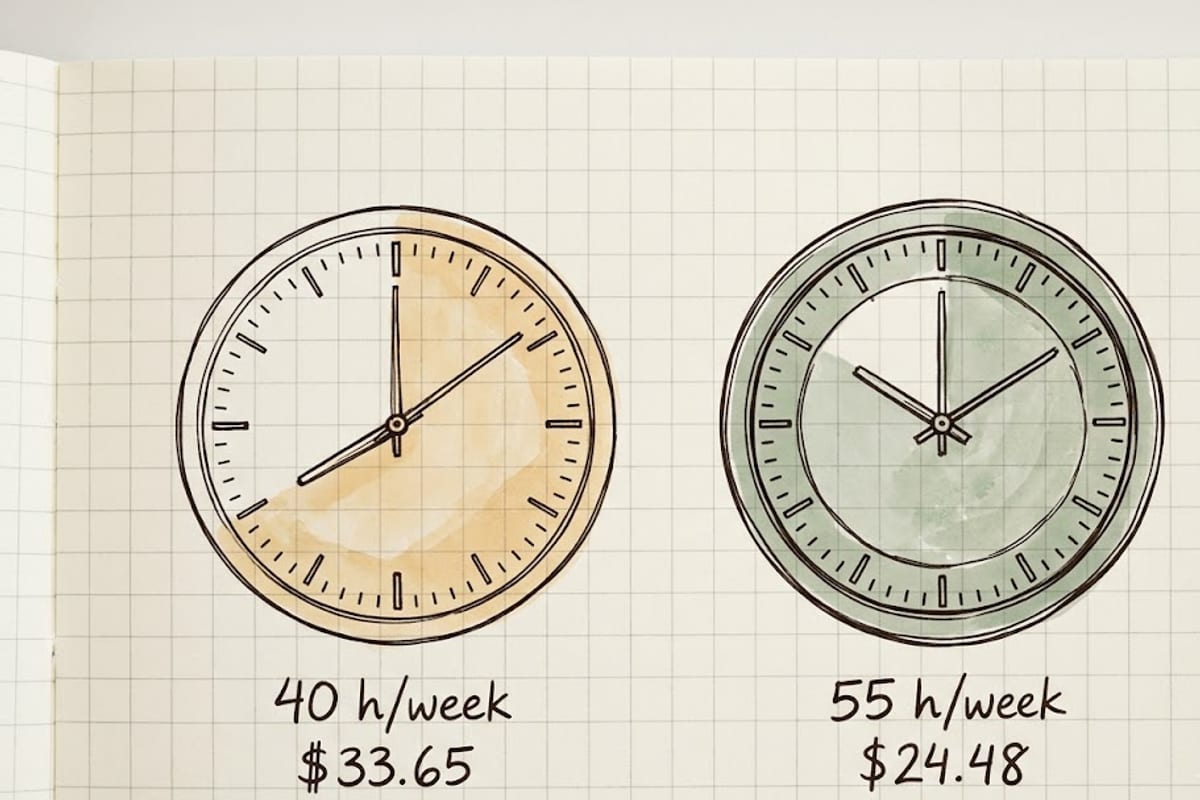
2,080 is forty hours times fifty-two weeks. It is a convention, and for salaried work it is frequently wrong.
| Salary | Real hours/week | Real hourly |
|---|---|---|
| $70,000 | 40 | $33.65 |
| $70,000 | 45 | $29.91 |
| $70,000 | 50 | $26.92 |
| $70,000 | 55 | $24.48 |
| $70,000 | 60 | $22.44 |
A $70,000 job at 55 hours a week pays $24.48 an hour — less than a $52,000 job at 40 hours, which pays $25.
Exempt salaried employees are owed nothing for hours past 40, so those hours are free to the employer. That is the structural reason salaried roles advertise well and compare badly, and it is why the conversion has to run on actual hours to mean anything.
Ask about typical hours in an interview. It is a normal question and the answer is more informative than the salary.
What belongs in the comparison besides hours

Paid time off. Three weeks of paid leave against none is worth about 6% of salary. A salaried employee is paid through it; an hourly worker without it is not, and their real divisor is closer to 1,920 than 2,080.
Employer health contribution. Commonly $5,000 to $15,000 a year for family cover, and invisible in both numbers.
Retirement match. A 4% match is 4% of salary, and it is the only guaranteed return available anywhere in personal finance.
Overtime eligibility. A non-exempt hourly worker who regularly works 50 hours earns time and a half for ten of them. That is worth 25% more than the base rate over a year, and it flips many salaried-versus-hourly comparisons on its own.
Add those up and a total compensation figure commonly runs 20 to 30% above the salary line.
Where the conversion is used against you
Two places it comes up in negotiation, both worth recognising.
"This works out to more per hour than your current job." True only at 40 hours, and the person saying it usually knows what the real hours are. Ask for the number the team actually works, not the number on the contract.
"We can't match that salary, but the role is more flexible." Flexibility has real value and it is not a wage. Price it: two days a week at home saves a commute worth perhaps $80 a week in time and fuel, which is around $4,000 a year. If the salary gap is $12,000, flexibility covers a third of it.
The same discipline applies in reverse when comparing a contract or freelance rate against a salary. A contractor at $60 an hour is not earning twice a $60,000 salaried employee: no paid leave, no employer payroll tax contribution, no health cover, no retirement match, and unbillable time between engagements. The conventional adjustment is that a contract rate needs to be roughly 1.5 to 2× the salaried hourly equivalent to be comparable, and the higher end applies where work is intermittent.
Going the other way
annual = hourly × 2,080
For an hourly worker the divisor assumption cuts the opposite way: without paid leave, two unpaid weeks makes it 2,000 and four makes it 1,920. With regular overtime it goes the other direction, past 2,080.
Either way, the honest annual figure comes from hours actually paid, not from the convention.
The conversion tables at $25 and $30 an hour work through the tax side, and overtime has its own rules that change the arithmetic again.