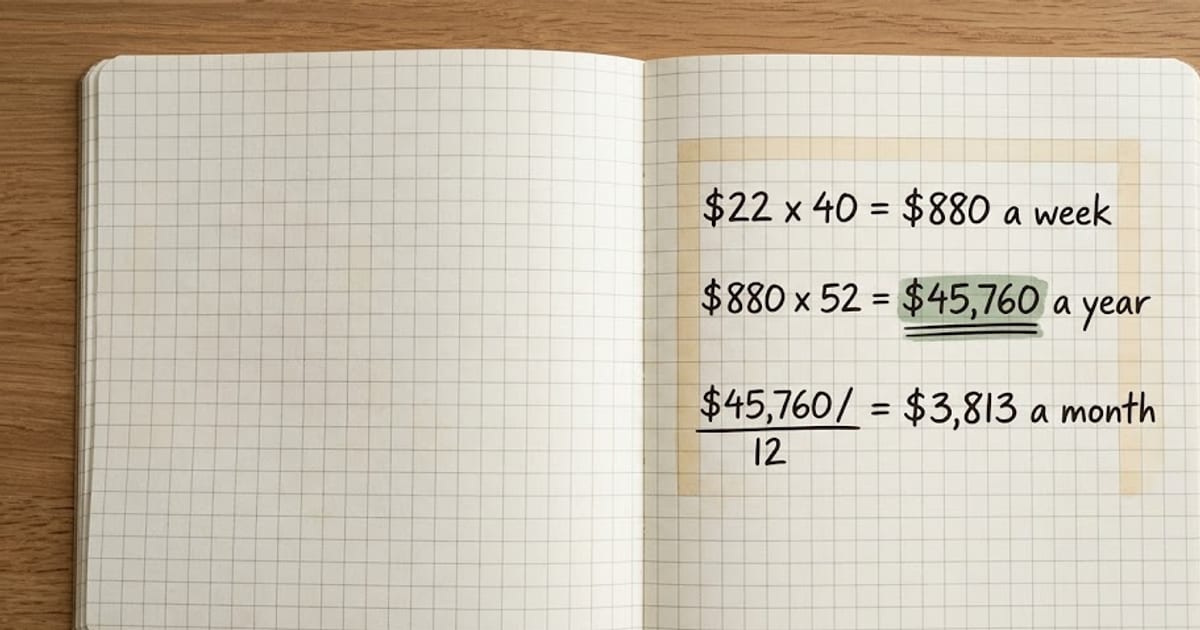
Multiply the hourly rate by the hours you work in a week, then multiply by 52. At a standard 40-hour week, that is the same as multiplying the hourly rate by 2,080. At $22 an hour, 22 × 40 × 52 = $45,760 a year before tax.
That formula assumes you are paid for every one of the 52 weeks, you work the same hours each week, and none of those hours are overtime. When any of those assumptions is wrong, the real annual figure moves, and the rest of this page covers how to adjust for each one.
The formula, step by step
- Hourly rate × hours per week = weekly pay. $22 × 40 = $880.
- Weekly pay × 52 = annual pay. $880 × 52 = $45,760.
- Annual pay ÷ 12 = average monthly pay. $45,760 ÷ 12 = $3,813.
The monthly step divides by 12, not by four. A month averages 4.33 weeks, so multiplying weekly pay by four understates monthly income by about 8%. At $880 a week, four weeks is $3,520, while the true monthly average is $3,813. The gap matters when you budget rent against a monthly figure.
The shortcut and how far off it is
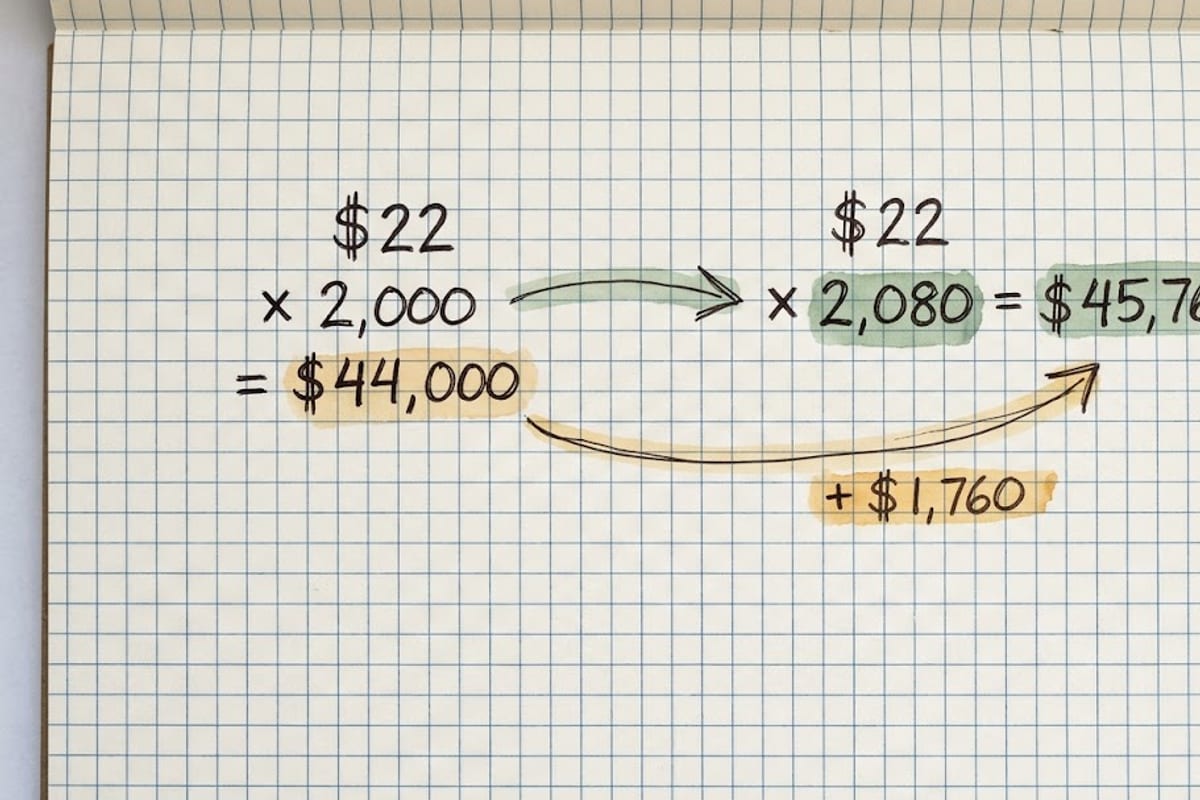
The common mental trick is to double the hourly rate and add three zeros. $22 becomes $44,000. That is the same as multiplying by 2,000 instead of 2,080, so it always comes out 3.8% low. At $22 an hour the shortcut misses $1,760 a year. At $40 an hour it misses $3,200.
The shortcut is still useful because it is fast and because 2,000 happens to be close to the number of hours people actually work once holidays are removed. Treat it as a floor for a full-time job with unpaid holidays, and 2,080 as the figure an employer or lender will quote.
Annual pay at common rates and schedules
| Hourly rate | 20 hrs/week | 30 hrs/week | 35 hrs/week | 37.5 hrs/week | 40 hrs/week |
|---|---|---|---|---|---|
| $15 | $15,600 | $23,400 | $27,300 | $29,250 | $31,200 |
| $17.50 | $18,200 | $27,300 | $31,850 | $34,125 | $36,400 |
| $20 | $20,800 | $31,200 | $36,400 | $39,000 | $41,600 |
| $22 | $22,880 | $34,320 | $40,040 | $42,900 | $45,760 |
| $25 | $26,000 | $39,000 | $45,500 | $48,750 | $52,000 |
| $30 | $31,200 | $46,800 | $54,600 | $58,500 | $62,400 |
| $35 | $36,400 | $54,600 | $63,700 | $68,250 | $72,800 |
| $40 | $41,600 | $62,400 | $72,800 | $78,000 | $83,200 |
| $50 | $52,000 | $78,000 | $91,000 | $97,500 | $104,000 |
Every figure is the rate times weekly hours times 52, before tax. Exact pages for any combination are in the calculator, for example $17.50 an hour at 37.5 hours a week.
Part-time and irregular hours
For a steady part-time schedule, the formula is unchanged: use the real weekly hours. $18 an hour at 25 hours a week is 18 × 25 × 52 = $23,400, which matches the $18 an hour at 25 hours page.
When hours change from week to week, do not guess a typical week. Add up the hours from your last several pay stubs and divide by the number of weeks they cover. Three months of stubs is enough to smooth out a single busy or quiet week. Use that average in place of 40. If your schedule is seasonal, a full year of stubs is the only reliable basis, and the easiest figure to use is the year-to-date gross on your final stub of the previous year.
Overtime raises the answer
If you regularly work more than 40 hours, multiplying all your hours by the base rate understates your pay. Under the Fair Labor Standards Act, non-exempt employees earn at least one and a half times their regular rate for every hour over 40 in a workweek.
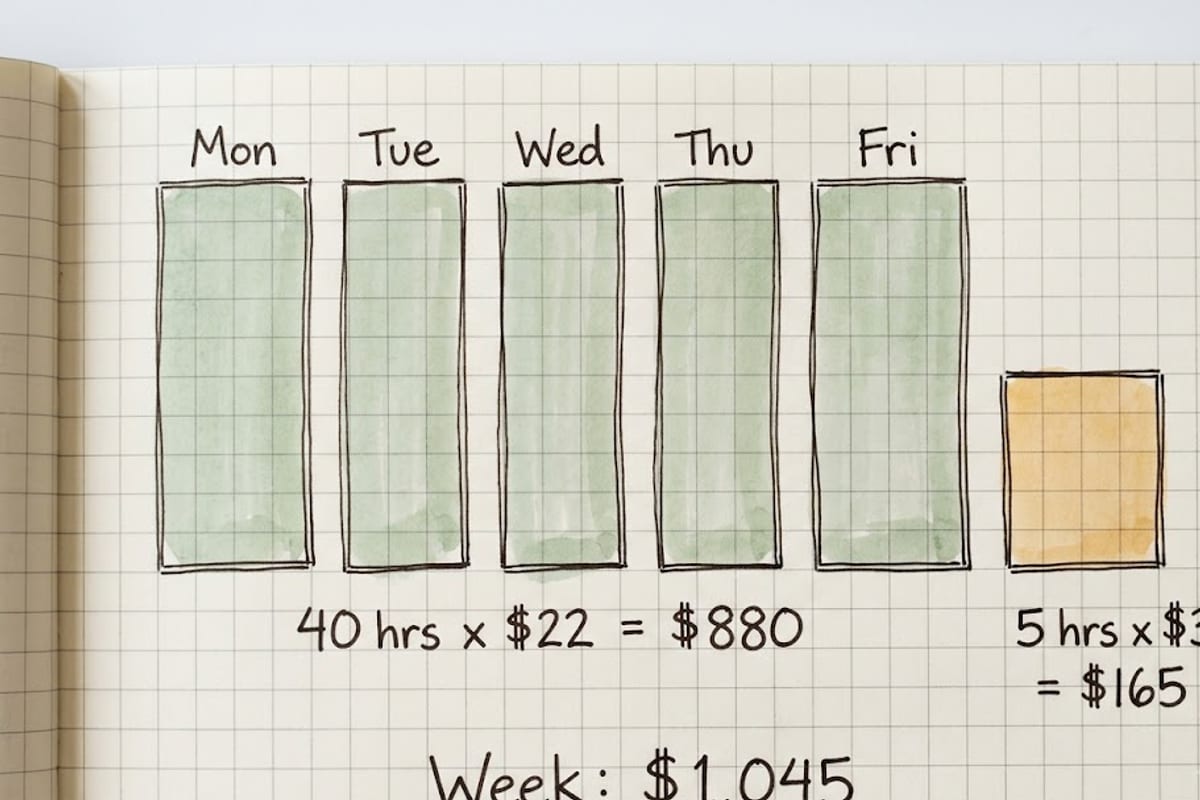
At $22 an hour and 45 hours a week, the naive calculation is 22 × 45 × 52 = $51,480. The correct one is (40 × $22 + 5 × $33) × 52 = $1,045 × 52 = $54,340. The five overtime hours each pay $33, and that difference is worth $2,860 a year. The $22 an hour at 45 hours a week page shows both figures side by side.
Overtime rules and exceptions are covered in how overtime pay is calculated, including the states that pay overtime by the day.
Unpaid weeks lower it
The 52 in the formula assumes you are paid every week of the year. Many hourly jobs do not pay for holidays or vacation. If you expect two weeks without pay, multiply by 50 instead of 52. At $22 an hour and 40 hours, that is $44,000 instead of $45,760.

Holidays are easy to overlook. If your employer closes on all 11 federal holidays and does not pay for them, that is 88 hours, or $1,936 at $22 an hour. The calendar itself also varies: 2026 has 261 weekdays, which is 2,088 hours rather than 2,080. The full breakdown is in how many work hours are in a year.
Converting the other way
To turn a salary into an hourly rate, divide by the hours. $50,000 ÷ 2,080 = $24.04 an hour. If you want the hourly value of the time you actually spend working, divide by the hours after holidays and vacation instead, which gives a higher figure. The method and its traps are in how to convert a salary to an hourly rate.
Gross versus take-home
Everything above is gross pay, before any tax or deduction. Your paycheck will be lower. For a single filer in 2026, federal income tax, Social Security (6.2%) and Medicare (1.45%) together take about 13% of gross pay at $15 an hour, 15% at $22 and 19% at $40, and state income tax adds more in most states. $45,760 a year gross becomes $38,948 in Texas, which has no state income tax. The take-home figure for your state is on the $22 an hour after taxes pages.
A worked example with everything in it
A warehouse worker earns $26 an hour, works 42 hours in a typical week, and takes one unpaid week at Christmas. Holidays are otherwise paid.
- Regular pay per week: 40 × $26 = $1,040
- Overtime per week: 2 × $39 = $78
- Weekly total: $1,118
- Weeks paid: 51
- Annual gross: $1,118 × 51 = $57,018
The simple formula, 26 × 2,080, gives $54,080. The real figure is almost $3,000 higher because the overtime outweighs the unpaid week. The only way to know which way your own numbers fall is to run each adjustment separately.
Frequently asked questions
What is the formula for hourly to annual salary? Hourly rate × hours per week × 52. For a 40-hour week, hourly rate × 2,080.
Why 2,080 hours? 40 hours a week times 52 weeks. It is a convention; the calendar holds slightly more in most years.
How do I calculate monthly pay from hourly? Annual pay divided by 12, or hourly rate × 173.33 at 40 hours a week. Do not multiply weekly pay by four.
How do I calculate annual salary if I work 12-hour shifts? Count hours per week. Three 12-hour shifts is 36 hours, which is under 40, so there is no federal overtime. Four 12-hour shifts is 48 hours, with 8 hours of overtime at time and a half. California and a few other states also pay daily overtime after 8 or 12 hours.
Sources
- U.S. Department of Labor, Wage and Hour Division: overtime pay under the Fair Labor Standards Act.
- U.S. Office of Personnel Management: federal holidays for 2026.
- Internal Revenue Service, Rev. Proc. 2025-32 (2026 tax brackets and standard deduction); Social Security Administration, 2026 wage base.