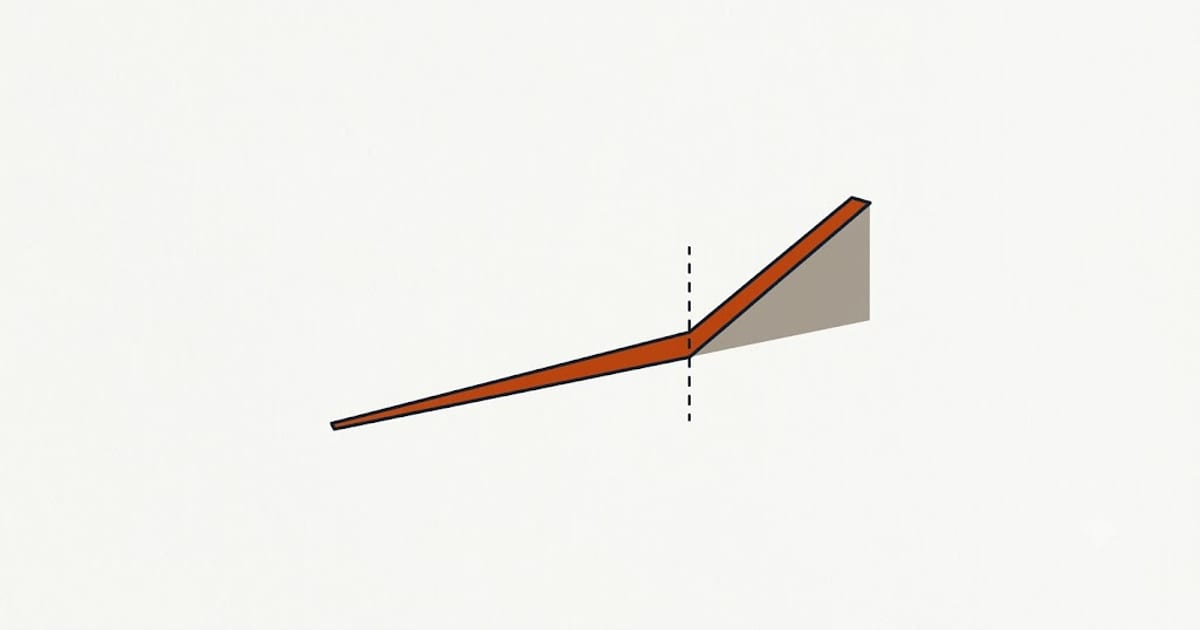
Overtime is one and a half times your regular rate for every hour over 40 in a workweek. That is the federal rule under the Fair Labor Standards Act, and it applies to non-exempt employees whether they are paid by the hour, by salary, or by the piece. To find your time-and-a-half rate, add half of your hourly rate to itself: $20 becomes $30, $25 becomes $37.50, $17 becomes $25.50.
| Base rate | Time and a half | Double time | 45-hour week | 50-hour week | 5 OT hours a week, per year |
|---|---|---|---|---|---|
| $15 | $22.50 | $30.00 | $712.50 | $825.00 | $5,850 |
| $17 | $25.50 | $34.00 | $807.50 | $935.00 | $6,630 |
| $18 | $27.00 | $36.00 | $855.00 | $990.00 | $7,020 |
| $20 | $30.00 | $40.00 | $950.00 | $1,100.00 | $7,800 |
| $22 | $33.00 | $44.00 | $1,045.00 | $1,210.00 | $8,580 |
| $25 | $37.50 | $50.00 | $1,187.50 | $1,375.00 | $9,750 |
| $30 | $45.00 | $60.00 | $1,425.00 | $1,650.00 | $11,700 |
| $35 | $52.50 | $70.00 | $1,662.50 | $1,925.00 | $13,650 |
| $40 | $60.00 | $80.00 | $1,900.00 | $2,200.00 | $15,600 |
Weekly figures are 40 hours at the base rate plus the overtime hours at time and a half, before tax. The last column is five overtime hours a week for 52 weeks.
Calculating a week with overtime
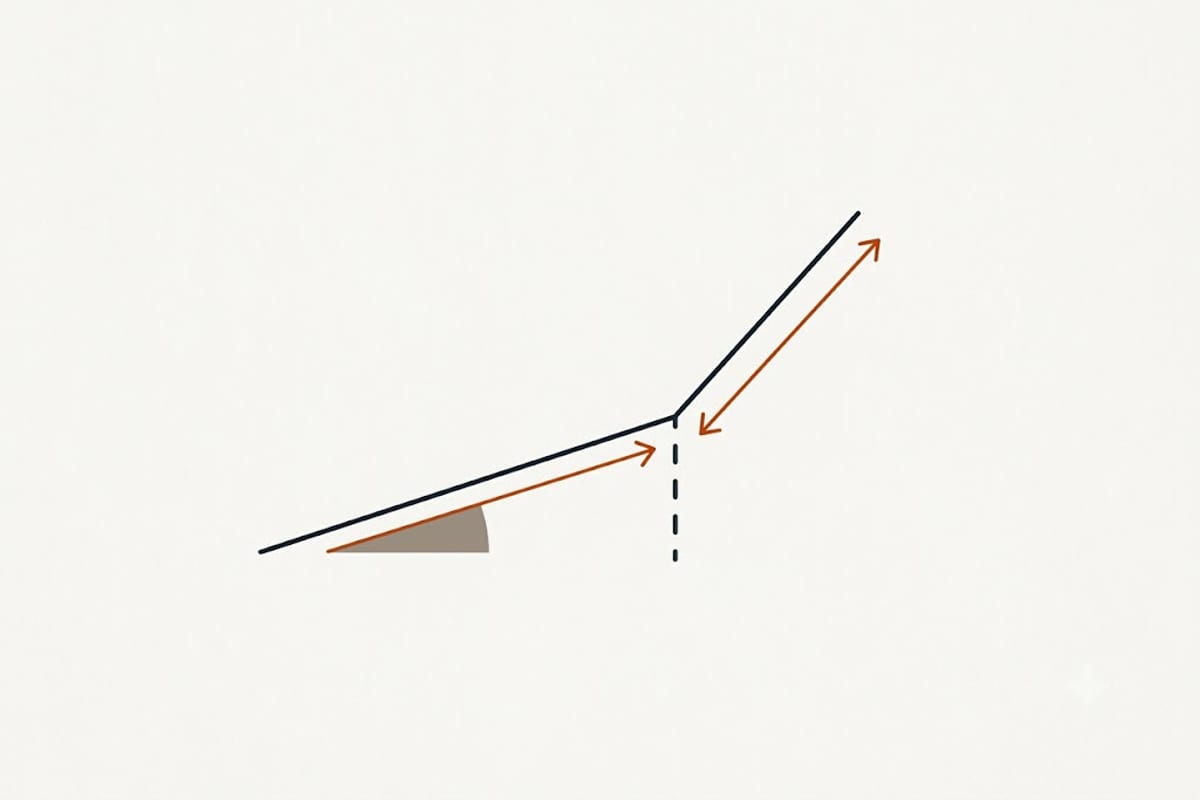
The method has three steps.
- Count hours worked in the workweek. Only hours actually worked count. Paid holidays, vacation and sick time do not count toward the 40 under federal law, even though they are paid.
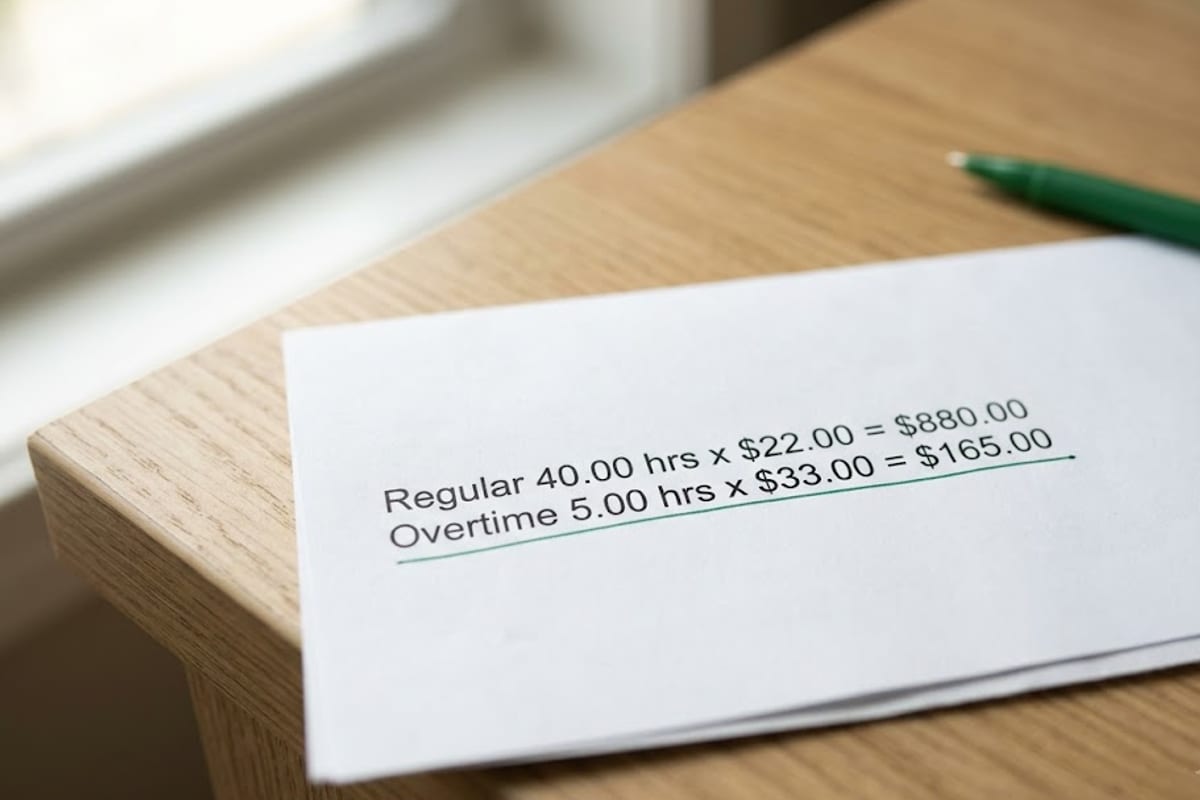
- Pay every hour at the regular rate. At $22 an hour and 45 hours, that is $990.
- Add a half-time premium for each hour over 40. 5 hours × $11 = $55. Total: $1,045.
Step 3 can also be written as 40 × $22 plus 5 × $33, which gives the same $1,045. The first way of writing it matters when the regular rate is not the same as your hourly rate, which is the next section.
The regular rate is not always the hourly rate
This is where most overtime disputes start. Overtime is 1.5 times the regular rate, and the regular rate includes more than the base hourly figure.
It includes non-discretionary bonuses, shift differentials, commissions, and production or piece-rate earnings. If a bonus is promised for hitting a target or for attendance, it is part of the regular rate for the weeks it covers.
It excludes genuinely discretionary gifts, expense reimbursements, and pay for time not worked, such as vacation and holidays.
Example: a bonus week
A worker earns $25 an hour, works 50 hours, and receives a $200 production bonus that week.
- Straight-time pay: 50 × $25 = $1,250, plus the $200 bonus = $1,450
- Regular rate: $1,450 ÷ 50 hours = $29.00, not $25
- Overtime premium: 10 hours × $14.50 (half of $29) = $145
- Total: $1,595
Paying overtime on $25 and adding the bonus separately gives $1,575, which is $20 short. Small in one week, it adds up across a year and across a workforce, and it is one of the most common wage claims.
Example: two different rates
A worker does 30 hours of one job at $20 and 15 hours of another at $30 for the same employer in the same week, 45 hours in total.
- Straight-time pay: $600 + $450 = $1,050
- Regular rate: $1,050 ÷ 45 = $23.33, a weighted average
- Overtime premium: 5 × $11.67 = $58.33
- Total: $1,108.33
Federal rules also allow the overtime hours to be paid at 1.5 times the rate of the work actually performed in those hours, if the worker and employer agree to that in advance.
Forty in a week, not eight in a day, federally

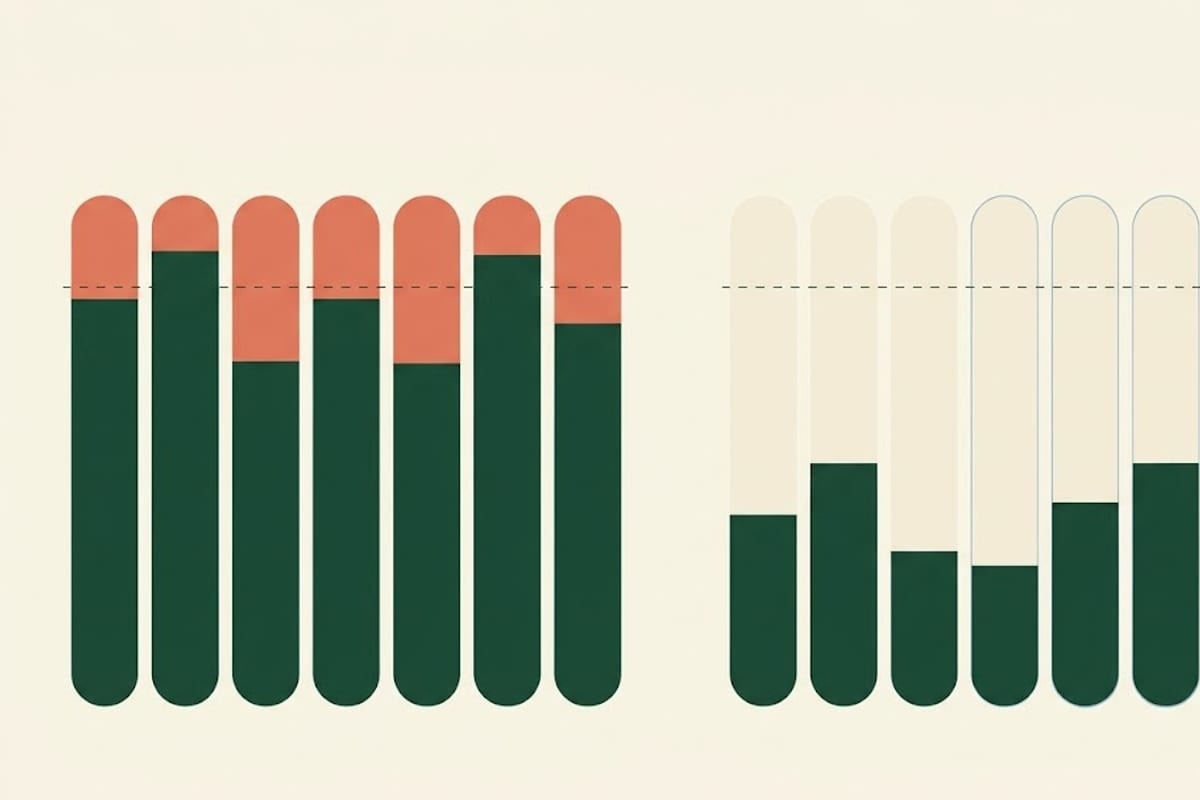
Federal law counts the week, not the day. Four ten-hour days is 40 hours and carries no federal overtime.
Several states go further and require overtime by the day:
- California: 1.5× after 8 hours in a day, 2× after 12 hours in a day, 1.5× for the first 8 hours on a seventh consecutive workday and 2× after that.
- Alaska: 1.5× after 8 hours in a day for employers with four or more employees.
- Nevada: 1.5× after 8 hours in a 24-hour period for employees earning less than 1.5 times the state minimum wage.
- Colorado: 1.5× after 12 hours in a day or 12 consecutive hours.
Where state law is more generous than federal law, the more generous rule applies. Where a union agreement is more generous than both, the agreement applies, which is common in construction and is one of the ways union pay packages are worth more than the base rate suggests.
What the workweek actually is
A workweek is a fixed and regularly recurring period of 168 consecutive hours, seven 24-hour days. An employer sets when it starts, and it does not have to match a calendar week, but it cannot be moved around to avoid overtime.
Hours cannot be averaged across two weeks. Fifty hours one week and thirty the next is ten hours of overtime, not zero. "Comp time" in place of overtime pay is not lawful for non-exempt private-sector employees; it is allowed only for public-sector employers under specific rules.
Who is exempt in 2026
Exempt employees are owed no overtime. Exemption depends on both a salary test and the duties actually performed: executive, administrative, professional, outside sales, and certain computer roles.
The federal salary threshold is $684 a week, or $35,568 a year. A 2024 rule that would have raised it was vacated by a federal court in Texas in November 2024, and in May 2026 the Department of Labor formally restored the $684 figure. Highly compensated employees earning at least $107,432 a year can be exempt under a lighter duties test.
Several states set much higher thresholds. California requires exempt employees to earn at least twice the state minimum wage for full-time work, which is $70,304 a year in 2026. Washington requires 2.25 times its minimum wage, or $80,168 in 2026. An employee who is exempt under federal law can still be owed overtime under state law.
The duties test is frequently misapplied. A job title including "manager" does not create an exemption; supervising two or more employees as a primary duty, with genuine authority over hiring and firing, is closer to the test. Being paid a salary does not create one either. Salaried non-exempt employees are owed overtime, calculated on a regular rate equal to the weekly salary divided by the hours the salary is meant to cover.
The federal overtime tax deduction, 2025 to 2028
Under the 2025 tax law, workers can deduct qualified overtime compensation from federal taxable income for tax years 2025 through 2028. The IRS explains the key limits:
- Only the premium portion counts: the "half" in time and a half, not the whole overtime wage.
- The deduction is capped at $12,500 a year, or $25,000 on a joint return.
- It phases out for modified adjusted gross income above $150,000, or $300,000 for joint filers.
- Only overtime required by the FLSA qualifies. Overtime paid under a state daily rule or a union contract, beyond what federal law requires, does not.
- Social Security, Medicare and state income taxes still apply to all overtime pay.
From 2026, employers report qualified overtime on Form W-2 in box 12 with code TT.
Example: a worker at $25 an hour who works 5 hours of overtime a week for 50 weeks has 250 overtime hours. The premium portion is 250 × $12.50 = $3,125. In the 12% bracket, deducting it saves about $375 in federal income tax. The deduction is claimed when filing, so paycheck withholding during the year may not reflect it.
What overtime is worth over a year
At $30 an hour, five overtime hours a week is $11,700 a year; ten hours a week is $23,400. At $22 an hour, five hours a week lifts a $45,760 salary to $54,340, which you can see on the $22 an hour at 45 hours a week page.
In trades where overtime is routine, that is the gap between the advertised base rate and what people actually earn, and it is already inside the BLS annual means used across this site, which is why the pay figures for trade jobs often read above a quoted hourly rate. How to fold regular overtime into an annual estimate is covered in how to calculate annual salary from an hourly rate, and the annual conversion pages show the base figures at each rate.
Frequently asked questions
How do I calculate time and a half? Multiply your regular rate by 1.5. For $18 an hour, that is $27. Then multiply by the number of hours over 40.
Is overtime pay required on holidays or weekends? Not under federal law. Weekend and holiday hours count toward the 40 like any other hours, and only hours over 40 must be paid at time and a half. Premium pay for holidays is an employer or contract policy.
Can my employer make me work overtime? Under federal law, yes, for employees 16 and older, as long as the overtime is paid. Some states limit mandatory overtime for nurses and certain other workers.
Is double time required? Not under federal law. California requires it after 12 hours in a day and after 8 hours on the seventh consecutive workday.
Sources
- U.S. Department of Labor, Wage and Hour Division: Fact Sheet #23 (overtime under the FLSA), Fact Sheet #56C (bonuses and the regular rate), and the May 14, 2026 technical amendment restoring the $684 salary level.
- Internal Revenue Service: "What to know about the No Tax on Overtime deduction" and related questions and answers.
- California Labor Code section 510; Washington Department of Labor & Industries, 2026 exempt salary threshold; Alaska, Nevada and Colorado state overtime rules.