
$20 an hour is $41,600 a year at 40 hours a week for 52 weeks, $3,467 a month before tax and about $2,967 a month after federal tax, Social Security and Medicare in a state with no income tax.
It is a good wage for a first job or for many entry-level positions. It is higher than the typical pay of cashiers, retail salespeople, stockers, home health aides and security guards, and it is almost exactly the median for full-time workers aged 16 to 24. It is a low wage for supporting an adult life on its own. MIT's living wage for one adult with no children is above $20 in every state except West Virginia, and roughly four out of five full-time workers in the country earn more.
Where $20 ranks among full-time workers
The Bureau of Labor Statistics reports usual weekly earnings for full-time wage and salary workers each quarter. In the second quarter of 2026 the 10th percentile was $642 a week and the 25th percentile was $850. At 40 hours, those are about $16.05 and $21.25 an hour.
$20 an hour is $800 a week. That places it at roughly the 21st percentile: about one full-time worker in five earns less and four in five earn more. The full-time median is $1,251 a week, about $31.28 an hour.
Age changes that picture a great deal. BLS puts the median for full-time workers aged 16 to 24 at $806 a week, which is $20.15 an hour. For that age group $20 is the middle. For ages 25 to 34 the median is $1,160 a week ($29 an hour), and for ages 35 to 44 it is $1,436 ($35.90 an hour).

So the same $20 offer means different things at different points. At 20 or 22 it is ordinary pay for someone early in their working life. At 40 it is about 44% below the median for that age.
Jobs that pay around $20
These are the May 2025 national medians from the BLS Occupational Employment and Wage Statistics survey for some of the largest hourly occupations.
| Occupation | Median hourly |
|---|---|
| Fast food and counter workers | $15.00 |
| Cashiers | $15.81 |
| Childcare workers | $16.82 |
| Retail salespersons | $17.03 |
| Home health and personal care aides | $17.21 |
| Janitors and cleaners | $17.71 |
| Stockers and order fillers | $17.95 |
| Receptionists and information clerks | $18.27 |
| Security guards | $18.28 |
| Hand laborers and material movers | $19.35 |
| Nursing assistants | $20.32 |
| Customer service representatives | $21.53 |
| Light truck drivers | $21.57 |
| Office clerks, general | $21.64 |
| Medical assistants | $21.97 |
| Pharmacy technicians | $22.00 |
In the first ten rows, $20 is above the national median for the job. An offer of $20 to stock shelves, work a register or do home care is a good offer by national standards, although pay in expensive metros and in states with high minimum wages is often higher.
In the last six rows, $20 is at or a little below the median. Those are also jobs where a short certificate or a year of experience moves pay up quickly: medical assistants, pharmacy technicians and nursing assistants all have formal training routes that start from roughly this wage.
The overall median for all jobs in the survey is $24.51 an hour, and the federal minimum wage is still $7.25.
What $20 an hour pays

| Period | Gross | After federal tax and FICA, no state tax |
|---|---|---|
| Hour | $20.00 | $17.12 |
| Week (40 hours) | $800 | $685 |
| Two weeks | $1,600 | $1,369 |
| Month (average) | $3,467 | $2,967 |
| Year | $41,600 | $35,606 |
A single filer on $41,600 has $25,500 of taxable income after the 2026 standard deduction of $16,100. Federal income tax on that is $2,812, and Social Security and Medicare take $3,182. State tax lowers take-home further: to $34,895 in Ohio, $34,411 in California and $33,745 in New York. The $20 an hour take-home calculator covers the rest of the states.
Hours matter as much as the rate. At 32 hours a week $20 an hour is $33,280 a year. With five hours of overtime each week at time and a half, it is $49,400. Overtime above 40 hours in a week must be paid at 1.5 times the regular rate for non-exempt workers under federal law, and through 2028 the extra half of that pay can be deducted from federal taxable income, up to $12,500 a year.
The living-wage test
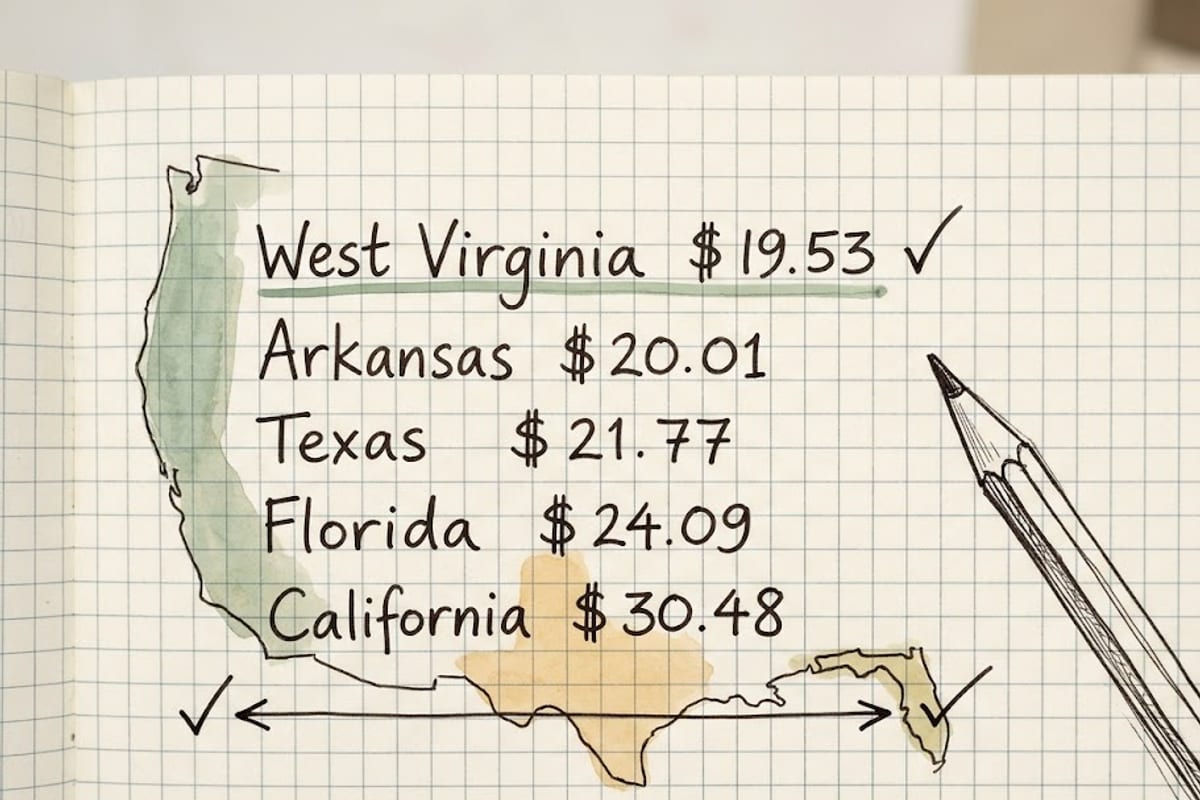
The MIT Living Wage Calculator estimates the hourly wage one full-time adult needs to cover a basic budget with no savings: rent at fair-market level, food, health care, transportation, phone and internet, other necessities and taxes. From its February 2026 state data:
| State | Living wage, one adult, no children |
|---|---|
| West Virginia | $19.53 |
| Arkansas | $20.01 |
| Kentucky | $20.21 |
| Louisiana | $20.37 |
| Mississippi | $20.69 |
| Texas | $21.77 |
| Florida | $24.09 |
| Washington | $26.59 |
| New York | $29.89 |
| California | $30.48 |
| Hawaii | $31.01 |
$20 is below the figure in 50 of 51 states and the District of Columbia. In Arkansas, Kentucky and Louisiana the gap is under 40 cents an hour, which a shared apartment or a paid-off car can close. In the most expensive states it is $10 or more an hour.
With a child the gap is much larger. MIT's living wage for one adult with one child is at least $32.68 an hour in every state, the lowest being Mississippi.
The MIT figure is a floor. It covers necessities for one person living alone and nothing else. Many people on $20 an hour live with a partner or roommates, which halves the largest cost in the budget.
Common routes from $20 to $25 and beyond
The occupations just above $20 in the BLS data share one feature: most of them are reached through a short, specific credential rather than a degree. The national medians from May 2025 show how far each route moves pay.
| Step from a $20 job | Typical training | Median hourly |
|---|---|---|
| Pharmacy technician | Certificate, often under a year | $22.00 |
| Medical assistant | Certificate, about a year | $21.97 |
| Heavy and tractor-trailer truck driver | Commercial driver's license | $28.19 |
| Licensed practical nurse | State-approved program, about a year | $30.96 |
| Electrician | Paid apprenticeship, four to five years | $30.38 |
These are national medians, so local rates will differ, but the spread is the useful part. A licensed practical nurse earns about 55% more than $20 an hour at the median, and an electrician's apprenticeship pays wages during the training itself. Moving from $20 to $25 an hour adds $10,400 a year before tax at full-time hours, which is about $8,360 after federal tax and FICA for a single filer in a state with no income tax. The $25 an hour page runs the same tests one step up.
Experience within the same job also counts. The BLS median for first-line supervisors of retail workers is $23.33 an hour, so a promotion from the sales floor to a shift lead or supervisor role typically lands a little above $20 even without a new credential.
So is it good?
$20 an hour is a good wage when it is one of these:
- a first or second job, especially under 25, where it matches or beats the typical pay for the age group;
- a job in a low-cost state, shared housing, or a household with a second income;
- a starting rate in a field with a clear step up, such as a certified medical assistant or a commercial driver's license.
It is a weak wage when it has to support a household alone, in a high-cost metro, or when there is no route to a higher rate. The practical questions are the same ones that apply to any offer: what the job normally pays locally, how many hours are guaranteed, and what the next step pays. If the answer to the third is also about $20, the job is worth treating as temporary.
Frequently asked questions
Is $20 an hour good for a 20-year-old? Yes. It matches the median full-time pay for workers aged 16 to 24 and is above the national median for most entry-level retail, food service and warehouse jobs.
Can you live on $20 an hour? Alone, in most states it covers a tight budget only with low rent or a roommate. The detailed budget is in can you live on $20 an hour.
How much is $20 an hour a month? $3,467 before tax on average and about $2,967 after federal tax and FICA. The monthly conversion page shows other schedules, and $20 an hour is how much a year covers unpaid weeks.
Is $20 an hour middle class? For an individual it is below the middle of full-time pay, around the 21st percentile. For a household it depends on the other earners.
Sources
- Bureau of Labor Statistics, Usual Weekly Earnings of Wage and Salary Workers, Second Quarter 2026, Tables 3 and 5.
- Bureau of Labor Statistics, Occupational Employment and Wage Statistics, May 2025, Table 1.
- MIT Living Wage Calculator, state data updated February 15, 2026.
- IRS Revenue Procedure 2025-32; IRS guidance on the qualified overtime deduction for 2025 through 2028.
- US Department of Labor, Fair Labor Standards Act overtime rules.