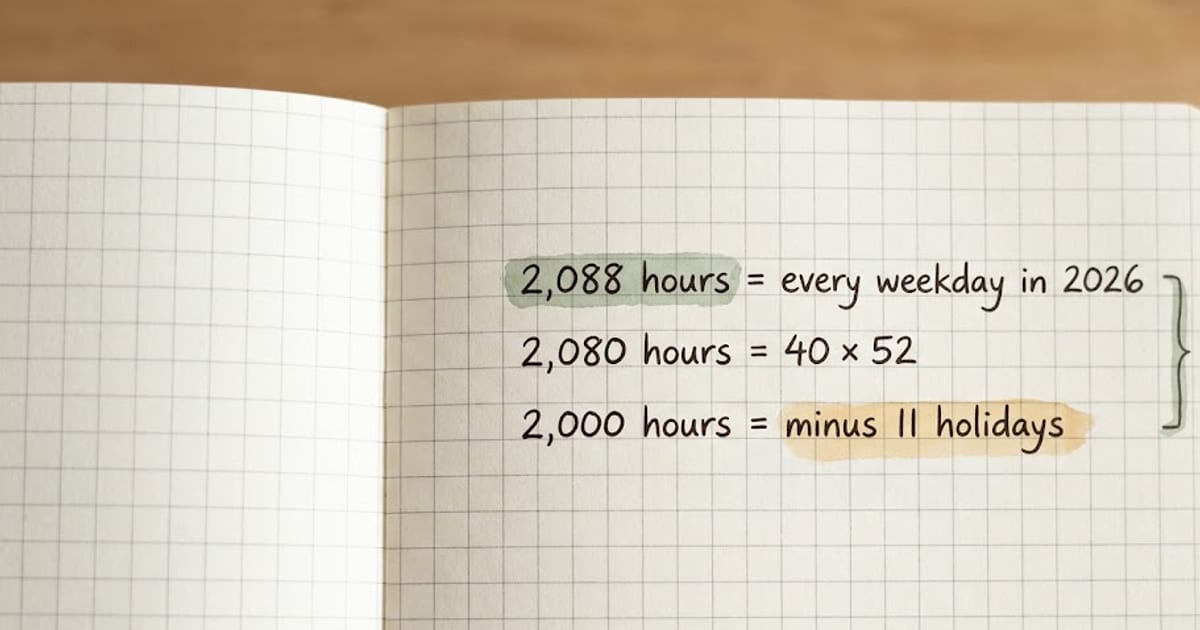
A calendar year holds 2,088 work hours in 2026. That is 261 weekdays at eight hours each. Take out the 11 federal holidays, all of which fall on a weekday this year, and the count drops to 2,000 hours. The figure most pay calculators use, 2,080, is simply 40 hours times 52 weeks, and it lands between the two.
Which number is right depends on what you are counting: the days the calendar allows, the days you are paid for, or the days you actually spend at work.
| Year | Starts on | Weekdays | Hours at 8 a day |
|---|---|---|---|
| 2024 | Monday (leap year) | 262 | 2,096 |
| 2025 | Wednesday | 261 | 2,088 |
| 2026 | Thursday | 261 | 2,088 |
| 2027 | Friday | 261 | 2,088 |
| 2028 | Saturday (leap year) | 260 | 2,080 |
| 2029 | Monday | 261 | 2,088 |
| 2030 | Tuesday | 261 | 2,088 |
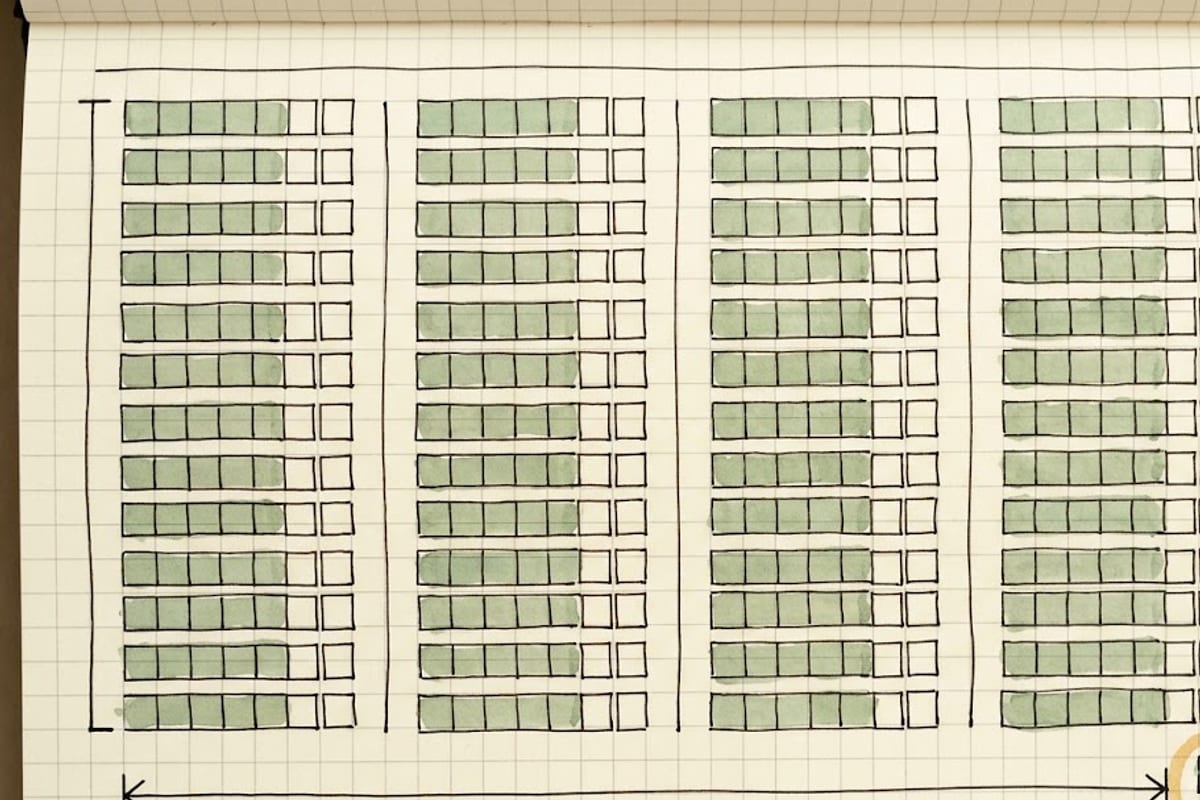
Why 52 weeks is always a little short
A year of 365 days is 52 weeks plus one day. In a leap year it is 52 weeks plus two days. Those leftover days are whatever weekday the year started on, and in a leap year the day after it as well.
2026 starts on a Thursday, so it has 53 Thursdays and one extra working day. That is where 2,088 comes from: 260 weekdays from the 52 full weeks, plus the extra Thursday. A year that starts on a Saturday, like 2028, has its spare day land on a weekend, and the count falls back to exactly 260 weekdays and 2,080 hours. A leap year that starts on a Monday, like 2024, picks up two extra weekdays and reaches 2,096.
This is why the 2,080 figure is a convention and not a count. It describes a year with no leftover days, which only happens when the spare day or days fall on a weekend.
Holidays: the 2,000-hour year
The federal government observes 11 paid holidays, and in 2026 every one of them lands on a weekday. Independence Day falls on a Saturday this year, so it is observed on Friday, July 3. The full list, from the U.S. Office of Personnel Management: New Year's Day (Jan. 1), Martin Luther King Jr.'s Birthday (Jan. 19), Washington's Birthday (Feb. 16), Memorial Day (May 25), Juneteenth (June 19), Independence Day observed (July 3), Labor Day (Sept. 7), Columbus Day (Oct. 12), Veterans Day (Nov. 11), Thanksgiving (Nov. 26) and Christmas (Dec. 25).
261 weekdays minus 11 holidays leaves 250 working days, or 2,000 hours.
Private employers are not required to give federal holidays off, and most give fewer. Many offer six to eight. If yours gives eight, your 2026 count is 253 days and 2,024 hours before any vacation.
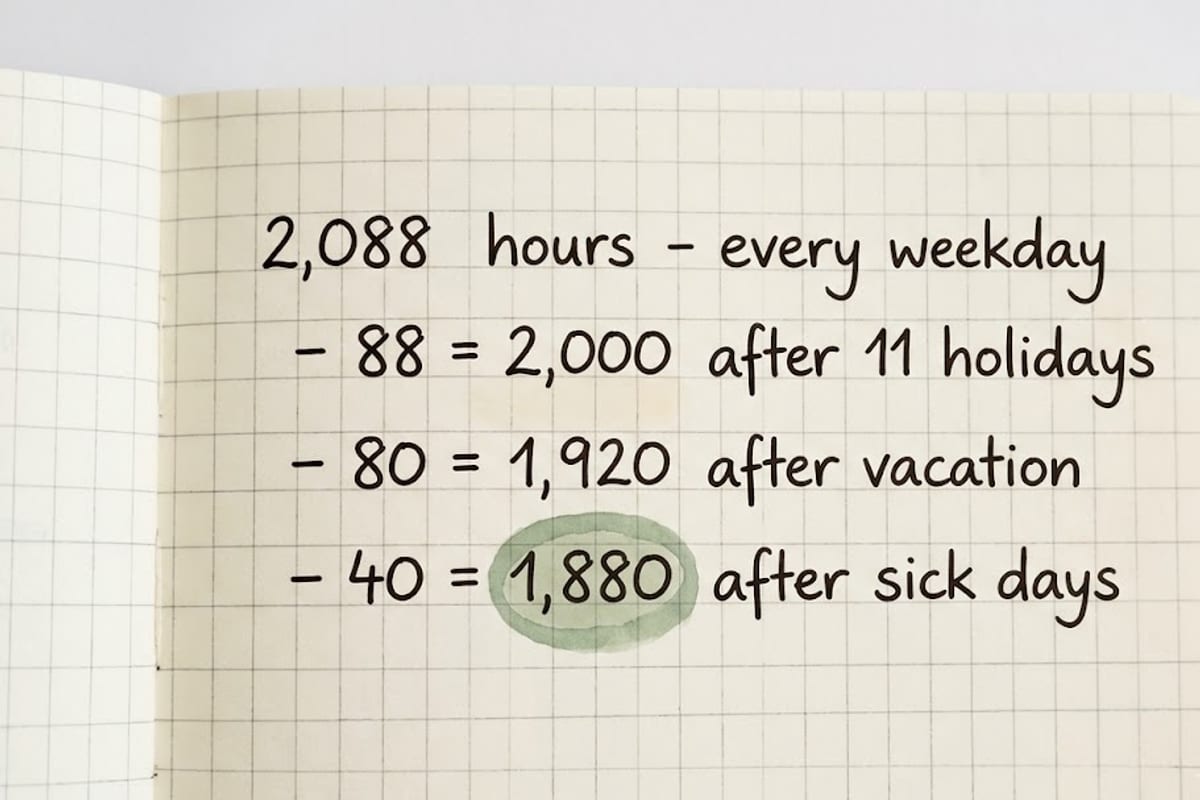
What vacation and sick time do to the count
| Starting from 2,088 hours in 2026 | Days left | Hours |
|---|---|---|
| Every weekday | 261 | 2,088 |
| Minus 11 federal holidays | 250 | 2,000 |
| Minus two weeks of vacation (10 days) | 240 | 1,920 |
| Minus five sick days | 235 | 1,880 |
| Minus three weeks of vacation instead of two | 230 | 1,840 |
For a salaried employee with paid leave, these subtractions do not change pay at all. The salary is the same whether you work 2,088 hours or 1,880. What changes is the effective hourly rate. A $60,000 salary works out to $28.85 an hour over 2,080 hours, $30.00 an hour over 2,000 hours, and $31.91 an hour over 1,880 hours. If you are comparing a salaried offer against an hourly one, the lower hour count is the fairer comparison, because it reflects the hours you actually give up.
For an hourly worker without paid leave, the subtractions come straight out of pay. At $25 an hour, the difference between a 2,080-hour year and a 1,920-hour year is 160 hours, or $4,000. You can see this directly by comparing $25 an hour at 40 hours a week against the same rate with unpaid weeks taken out further down that page.
Why the federal government uses 2,087
Federal employees have their hourly rate calculated by dividing annual pay by 2,087 hours, not 2,080. The Office of Personnel Management explains the reason: the calendar pattern of weekdays repeats every 28 years, and averaged across that cycle a year contains 2,087 work hours. The divisor was set in law in 1986 (5 U.S.C. 5504(b)).
Using 2,087 instead of 2,080 makes a small difference to the hourly rate. On a $75,000 salary, 2,080 hours gives $36.06 an hour and 2,087 hours gives $35.94. The federal method pays biweekly by multiplying that hourly rate by 80, so over a long career the averages come out even with the calendar.
How many hours people really work
The calendar sets the ceiling. Actual hours are lower for most people and higher for some.
The Bureau of Labor Statistics reports that the average workweek for all employees on private nonfarm payrolls was 34.4 hours in August 2026. That average includes part-time workers, which pulls it down. In manufacturing, where full-time schedules and overtime are common, the average was 40.5 hours, including 3.1 hours of overtime.
At 34.4 hours a week over 52 weeks, a year comes to about 1,789 hours. At the manufacturing average of 40.5 hours, it is about 2,106 hours, before any time off. The spread between those two figures is wider than the difference between any two calendar years.
Counting your own hours
Hourly workers are paid by the week, so the reliable way to know your real annual hours is to add up timesheets rather than start from the calendar. A week at 40.0 hours is the building block: 52 of them is 2,080, and every week that falls short or runs over moves the total.
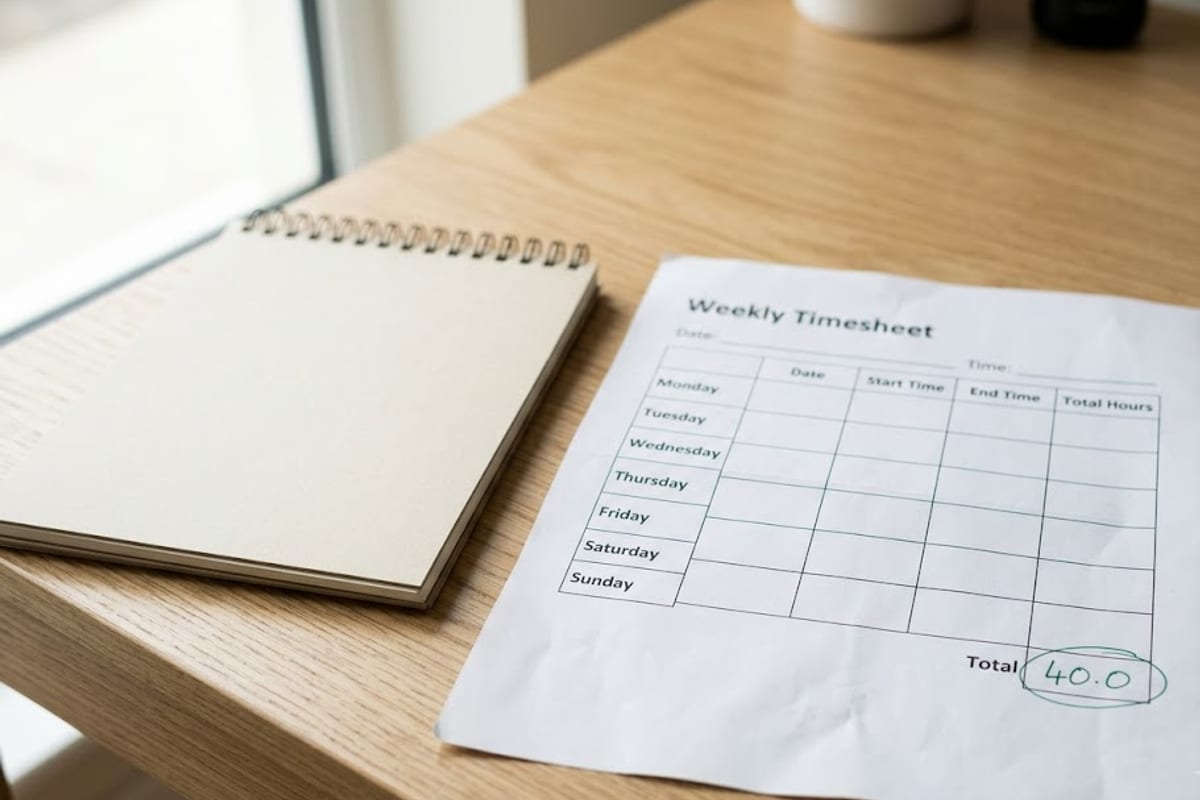
Your final pay stub of the year usually shows year-to-date hours as well as year-to-date pay. Dividing one by the other gives your true average hourly rate for the year, including overtime, and comparing the hours figure with 2,080 shows how far your year departed from the standard assumption.
Which number to use
For converting an hourly rate into an annual salary: use 2,080 unless you know otherwise. It is the number employers, lenders and most calculators assume, so your result will match theirs. $20 an hour becomes $41,600, and $30 an hour becomes $62,400.
For converting a salary into its real hourly value: use the hours you actually work. That usually means 2,000 or fewer after holidays and vacation. The method is covered in detail in how to convert a salary to an hourly rate.
For planning an hourly worker's income: start from 2,080, then subtract every unpaid day you expect to take. Holidays are unpaid for many hourly jobs, and that alone is 88 hours in 2026 if your employer closes on all 11.
For federal pay: 2,087 is required by law for most civilian federal employees.
Part-time years
The same arithmetic applies at fewer hours a week. At 30 hours a week, 52 weeks gives 1,560 hours. At 32 hours, a common four-day schedule, it is 1,664 hours. At 20 hours, 1,040. Each of these falls by the same proportion when holidays and unpaid leave are taken out. A worker on 30 hours a week who takes the 11 federal holidays unpaid loses 66 hours, since each holiday removes six scheduled hours.
What counts as full time for benefits and tax purposes is a separate question with several answers. The Bureau of Labor Statistics counts 35 hours or more as full time. The Affordable Care Act uses 30 hours a week, or 130 hours in a month, to decide which employees a large employer must offer health coverage to. Neither of these changes how many hours are in a year, but they matter for deciding whether a reduced schedule still carries benefits.
Frequently asked questions
How many work hours are in a year with two weeks off? In 2026, 2,088 weekday hours minus 80 hours of vacation is 2,008. If you also get the 11 federal holidays off, it is 1,920.
How many work hours are in a month? On average, 2,080 divided by 12 is 173.3 hours. Actual months vary between 160 and 184 hours depending on how many weekdays they contain. In 2026, February has 20 weekdays (160 hours) and July has 23 (184 hours).
Is 2,080 or 2,087 more accurate? Over a long period, 2,087 matches the calendar more closely. For any single year, counting the weekdays gives the exact figure: 2,088 for 2026.
How many hours is a year at 37.5 hours a week? 37.5 times 52 is 1,950 hours. Many salaried office jobs use this schedule, which assumes a 30-minute unpaid lunch in an eight-hour day.
Sources
- U.S. Office of Personnel Management, federal holidays for 2026, and "Computing Hourly Rates of Pay Using the 2,087-Hour Divisor."
- U.S. Bureau of Labor Statistics, The Employment Situation, August 2026 (average weekly hours).
- Internal Revenue Service, employer shared responsibility provisions (30 hours a week or 130 hours a month).
- Weekday counts calculated from the Gregorian calendar for each year.