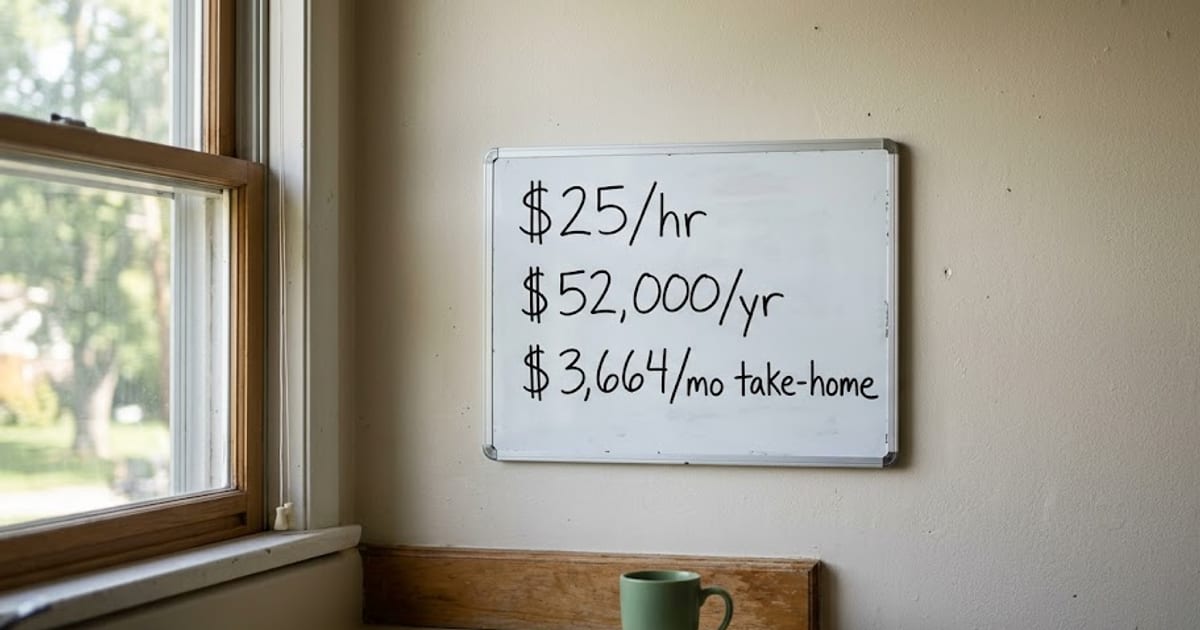
$25 an hour is $52,000 a year at 40 hours a week for 52 weeks. That is $1,000 a week and $4,333 a month before tax. A single filer keeps about $43,962 a year, or $3,664 a month, after federal income tax, Social Security and Medicare in a state without an income tax.
By national standards $25 is a solid wage. It is slightly above the median pay of all US jobs, and it covers MIT's living wage for one adult in 37 of the 51 states and the District of Columbia. It is also $5 an hour more than the pay of most entry-level retail, warehouse and care jobs. It sits below the median for full-time workers, and it does not cover a basic budget for a single parent anywhere.
Two different medians
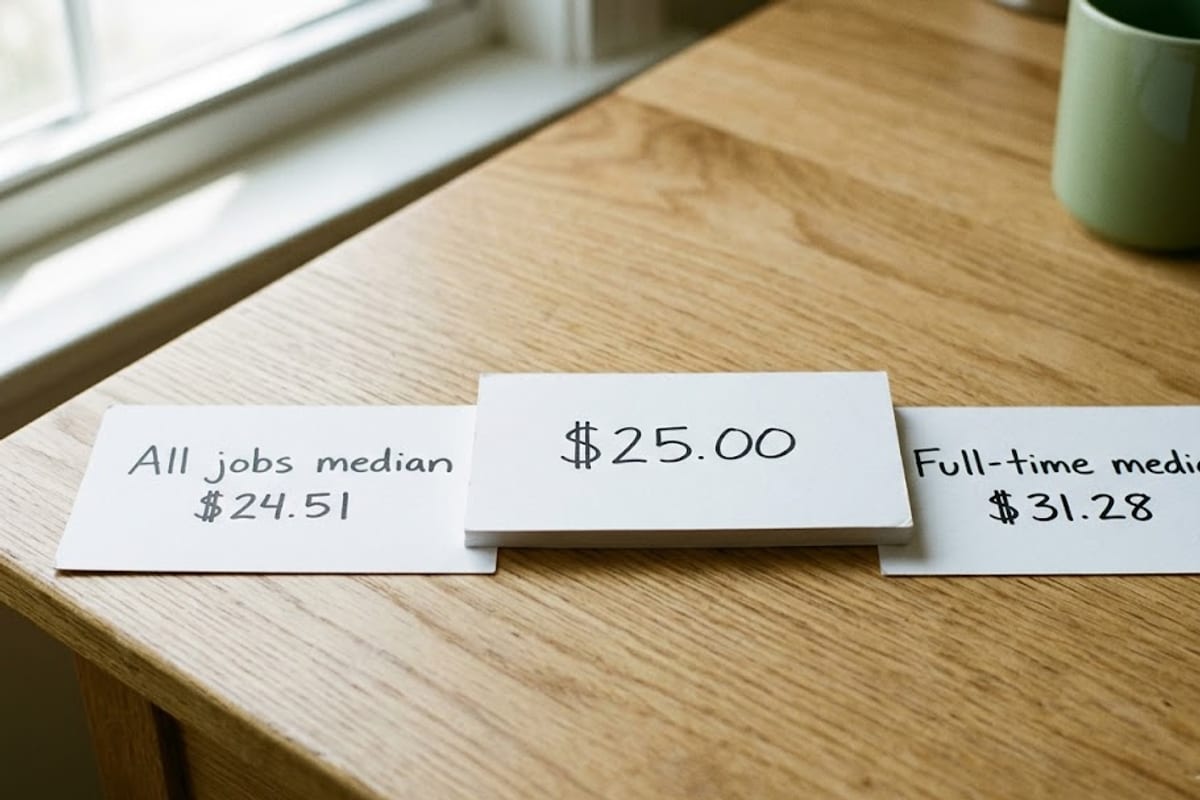
The Bureau of Labor Statistics publishes two measures that are often both called "the median wage," and $25 an hour falls between them.
The occupational survey covers every job, full time and part time, and its median for May 2025 was $24.51 an hour. At $25, a job pays more than half of all jobs in the country.
The quarterly earnings survey covers only people working full time. Its median for the second quarter of 2026 was $1,251 a week, which is $31.28 an hour at 40 hours. The 25th percentile was $850 a week. At $1,000 a week, $25 an hour is at roughly the 34th percentile of full-time workers, so about two in three full-time workers earn more.
Both statements are true. Compared with jobs as they are advertised, $25 is above average. Compared with the pay of adults who work full time all year, it is below the middle.
The living-wage test, state by state
The MIT Living Wage Calculator estimates the hourly wage a single full-time adult needs to cover rent, food, health care, transportation, phone and internet, other necessities and taxes, with nothing left for savings. Its February 2026 figures put that wage above $25 in 14 places:
| Where $25 falls short | Living wage, one adult | Gap per hour |
|---|---|---|
| Hawaii | $31.01 | $6.01 |
| Massachusetts | $30.58 | $5.58 |
| California | $30.48 | $5.48 |
| New York | $29.89 | $4.89 |
| New Jersey | $27.35 | $2.35 |
| District of Columbia | $26.72 | $1.72 |
| Washington | $26.59 | $1.59 |
| Oregon | $26.46 | $1.46 |
| Connecticut | $26.05 | $1.05 |
| Colorado | $26.00 | $1.00 |
| Maryland | $25.94 | $0.94 |
| New Hampshire | $25.77 | $0.77 |
| Virginia | $25.72 | $0.72 |
| Rhode Island | $25.01 | $0.01 |
In the other 37 states $25 clears the figure. The margin is thin in Alaska, Vermont, Maine and Utah, under 30 cents an hour, and widest in West Virginia at $5.47, Arkansas at $4.99, Kentucky at $4.79 and Louisiana at $4.63. In Texas the margin is $3.23 an hour, which is about $6,700 a year before tax.
For a single parent with one child, MIT's living wage is at least $32.68 an hour in every state, so $25 does not cover it anywhere. For two adults sharing expenses, one earning $25 and the other working even part time, the picture is much better.
Rent on $25 an hour
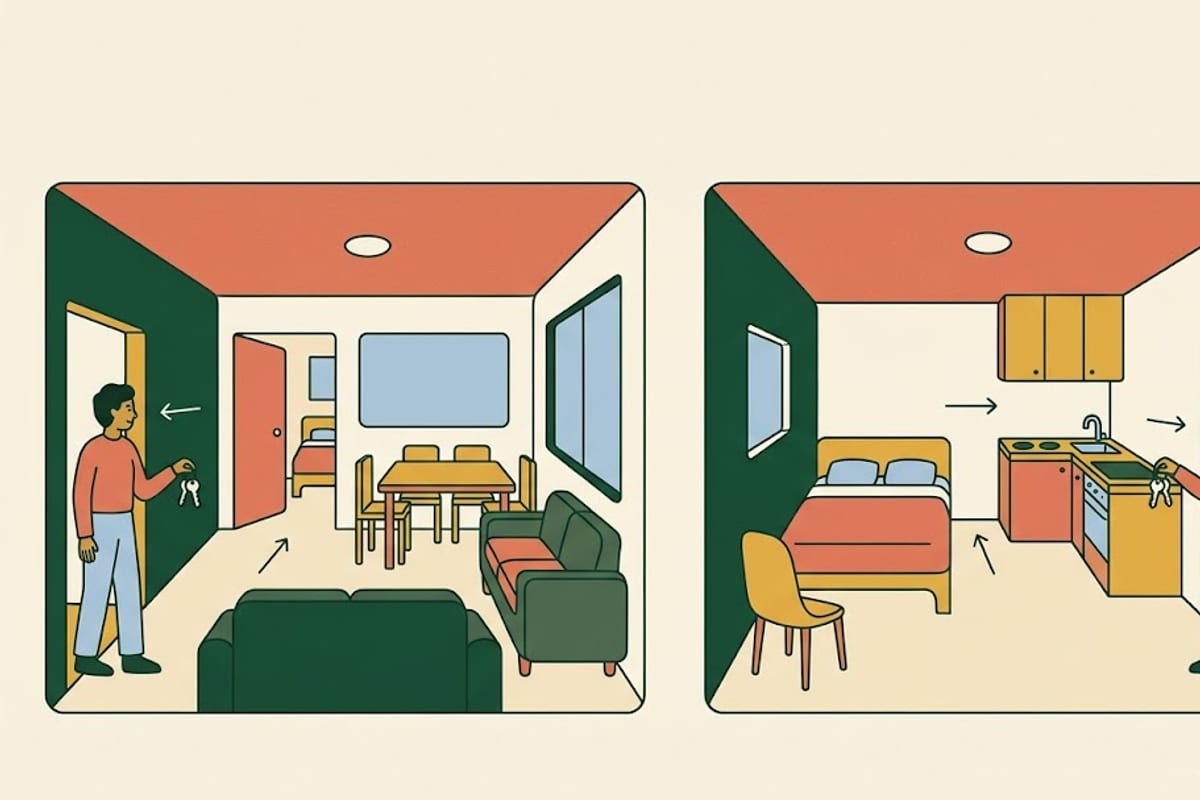
Thirty percent of $52,000 is $1,300 a month. MIT's monthly housing figure for one adult is $906 in Ohio, $1,223 in Texas, $1,437 in Colorado and $1,949 in California. In Ohio or Texas $1,300 rents a one-bedroom apartment at the typical local rate. In Colorado it is a studio or a shared unit, and in California it usually means a roommate.
| Monthly rent | Share of $3,664 take-home | Left after rent |
|---|---|---|
| $900 | 25% | $2,764 |
| $1,300 | 35% | $2,364 |
| $1,600 | 44% | $2,064 |
| $1,950 | 53% | $1,714 |
Overtime, unpaid weeks and part-time schedules
Hourly pay makes the annual figure depend on hours in a way a salary does not.

Overtime. Non-exempt workers are paid 1.5 times the regular rate for hours over 40 in a week, so overtime at $25 is $37.50 an hour. Five overtime hours a week add $187.50 to a $1,000 week, and over a full year that is $9,750. From 2025 through 2028 the extra half of overtime pay, here $12.50 an hour, can be deducted from federal taxable income up to $12,500 a year, which makes overtime noticeably more valuable after tax.
Unpaid time off. The 2,080-hour figure assumes every week is paid. Two unpaid weeks a year bring $52,000 down to $50,000. Paid holidays and vacation are available to most private-sector workers, but not all: BLS found paid holidays available to 81% of private industry workers in 2025.
Fewer hours. At 32 hours a week, $25 an hour is $41,600 a year, the same annual pay as a full-time job at $20. When comparing a $25 part-time offer with a $20 full-time one, the annual figure is the fair comparison.
| Schedule at $25 an hour | Annual gross |
|---|---|
| 40 hours, 52 paid weeks | $52,000 |
| 40 hours, 50 paid weeks | $50,000 |
| 45 hours (5 overtime), 52 weeks | $61,750 |
| 32 hours, 52 weeks | $41,600 |
The $25 an hour conversion page goes through more schedules, and the take-home calculator covers each state.
A $25 job with benefits against $25 without
Two offers at the same hourly rate can be worth very different amounts. The Bureau of Labor Statistics measures what employers spend on benefits on top of wages. In March 2026, for private-industry workers at the median wage level, employers paid $24.15 an hour in wages and $10.63 an hour in benefits, including $2.24 for paid leave and $3.51 for insurance. Benefits made up about 30% of total compensation across private industry.
At $25 an hour, that means a job with typical benefits carries roughly $10 an hour of value that does not appear in the pay rate: health coverage, paid time off, retirement contributions and the employer's share of Social Security and Medicare.
A $25 contract or gig rate with no benefits is therefore closer to a $17 or $18 employee wage once the worker pays for their own insurance and covers unpaid days. Self-employed workers also pay both halves of Social Security and Medicare, 15.3% instead of 7.65%, on most of their net earnings. When comparing a contract offer with an employee job, a common rule is that the contract rate needs to be 25% to 40% higher to come out even.
Jobs that pay around $25
From the BLS May 2025 national medians:
| Occupation | Median hourly |
|---|---|
| Construction laborers | $22.66 |
| Secretaries and administrative assistants | $22.86 |
| Dental assistants | $23.11 |
| Maintenance and repair workers, general | $23.84 |
| Automotive service technicians and mechanics | $24.34 |
| Bookkeeping, accounting and auditing clerks | $24.36 |
| Welders, cutters, solderers and brazers | $25.84 |
| Heavy and tractor-trailer truck drivers | $28.19 |
| Firefighters | $28.50 |
For most of these jobs, $25 is at or somewhat above the national median, so an offer at $25 is a fair market rate before adjusting for local pay levels. For truck drivers and firefighters it is below the national median.
Is it good for you
$25 an hour is a good wage in most of the country for a single adult, and a very good one in the lower-cost South and Midwest, where it leaves $4 to $5 an hour above a basic budget. It is a tight wage in the 14 high-cost places above unless housing is shared. As a sole income for a parent it falls short everywhere.
Compared with $20 an hour, it adds $10,400 a year before tax and about $8,360 after federal tax and FICA. The $20 an hour page shows how much that step changes the living-wage map: from one state to 37.
Frequently asked questions
Is $25 an hour a good wage in 2026? It is above the median for all US jobs and covers a basic single-adult budget in 37 of 51 states. It is below the median for full-time workers.
How much is $25 an hour a year after taxes? About $43,962 for a single filer in a state with no income tax. In Ohio it is $42,966, in California $42,117, in New York $41,495.
Is $25 an hour middle class? For one person it is in the lower-middle part of full-time pay. For a household it depends on other income; two adults each earning $25 an hour have $104,000 a year together.
Is a $25 an hour contract job better than a $22 an hour job with benefits? Usually not. At typical benefit levels an employee job carries several dollars an hour of insurance, paid leave and retirement value, and a contractor pays both halves of payroll tax. Price the contract rate against the full value of the employee package before deciding.
How much is $25 an hour biweekly? $2,000 before tax for 80 hours, and about $1,691 after federal tax and FICA in a state with no income tax.
Sources
- Bureau of Labor Statistics, Occupational Employment and Wage Statistics, May 2025, Table 1.
- Bureau of Labor Statistics, Usual Weekly Earnings of Wage and Salary Workers, Second Quarter 2026, Table 5.
- Bureau of Labor Statistics, National Compensation Survey, access to paid holidays, 2025.
- Bureau of Labor Statistics, Employer Costs for Employee Compensation, March 2026.
- MIT Living Wage Calculator, state data updated February 15, 2026.
- IRS Revenue Procedure 2025-32; IRS guidance on the qualified overtime deduction.