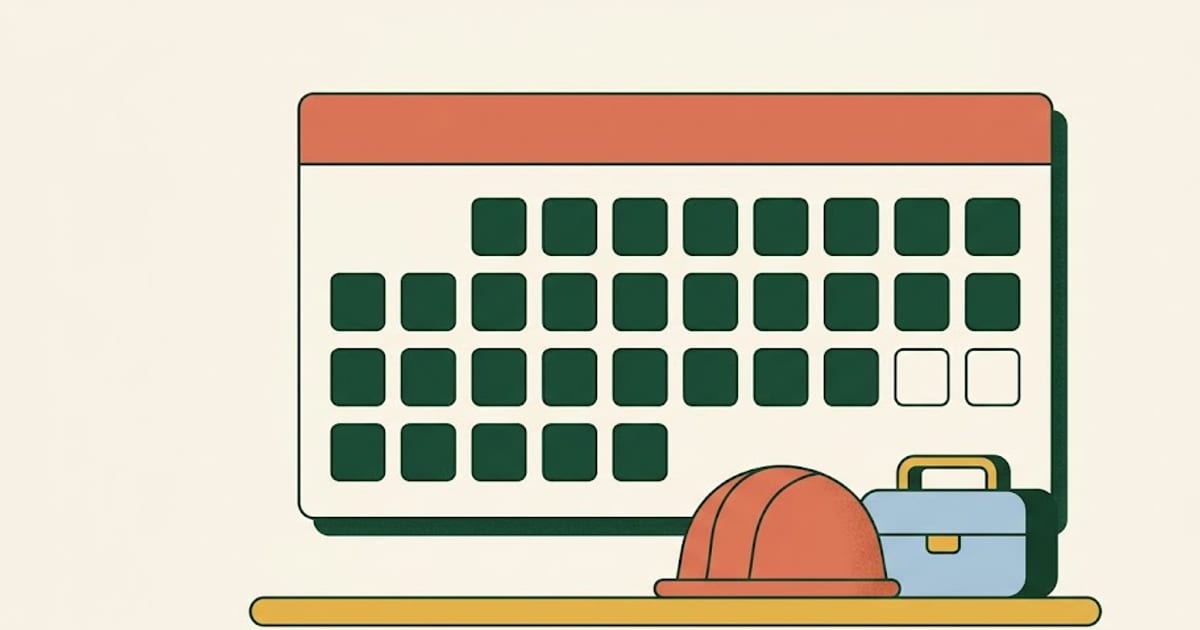
$25 an hour × 2,080 hours = $52,000 a year.
| Hourly | Annual (2,080 h) | Weekly | Monthly |
|---|---|---|---|
| $15 | $31,200 | $600 | $2,600 |
| $18 | $37,440 | $720 | $3,120 |
| $20 | $41,600 | $800 | $3,467 |
| $22 | $45,760 | $880 | $3,813 |
| $25 | $52,000 | $1,000 | $4,333 |
| $28 | $58,240 | $1,120 | $4,853 |
| $30 | $62,400 | $1,200 | $5,200 |
| $35 | $72,800 | $1,400 | $6,067 |
| $40 | $83,200 | $1,600 | $6,933 |
| $50 | $104,000 | $2,000 | $8,667 |
Going the other way: annual ÷ 2,080, or the quick version — halve the hourly rate and read it as thousands. $25 an hour is roughly $50k; $34 is roughly $68k. It is accurate to within 4%.
Where 2,080 comes from
40 hours × 52 weeks. It is a convention, and it embeds three assumptions.
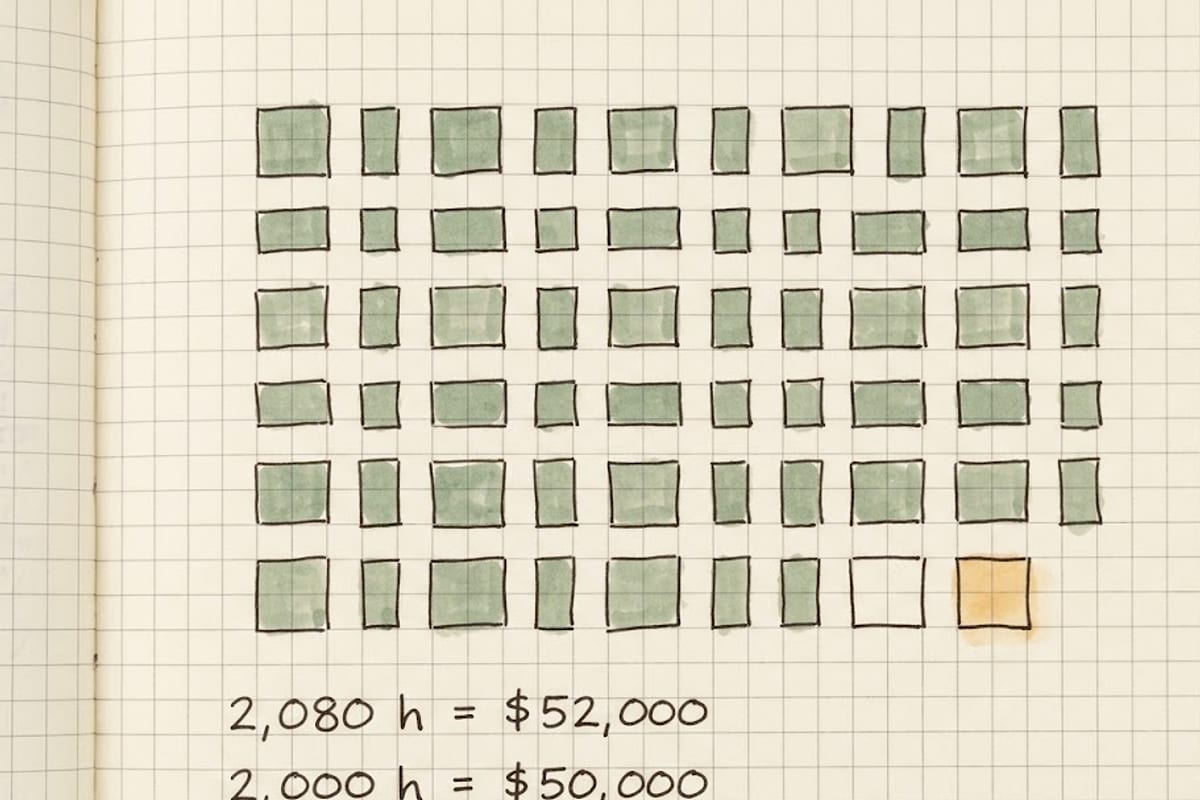
Every week is worked. Salaried employees are paid through holidays and leave, so 2,080 holds. Hourly employees without paid time off are not.
No unpaid time off. Two unpaid weeks turns 2,080 into 2,000, and $52,000 into $50,000.
No overtime. Where overtime is regular, the annual figure is higher than the conversion suggests — often substantially in trades and healthcare.
| Situation | Hours | At $25/h |
|---|---|---|
| Full year, paid leave | 2,080 | $52,000 |
| Two unpaid weeks | 2,000 | $50,000 |
| Four unpaid weeks | 1,920 | $48,000 |
| 45 h/week, 5 at time-and-a-half | 2,340 eq. | $58,500 |
| 30 h/week part-time | 1,560 | $39,000 |
Five overtime hours a week is worth $6,500 a year at this rate — 12.5% of the base for 12.5% more time, paid at 1.5×.
What actually arrives
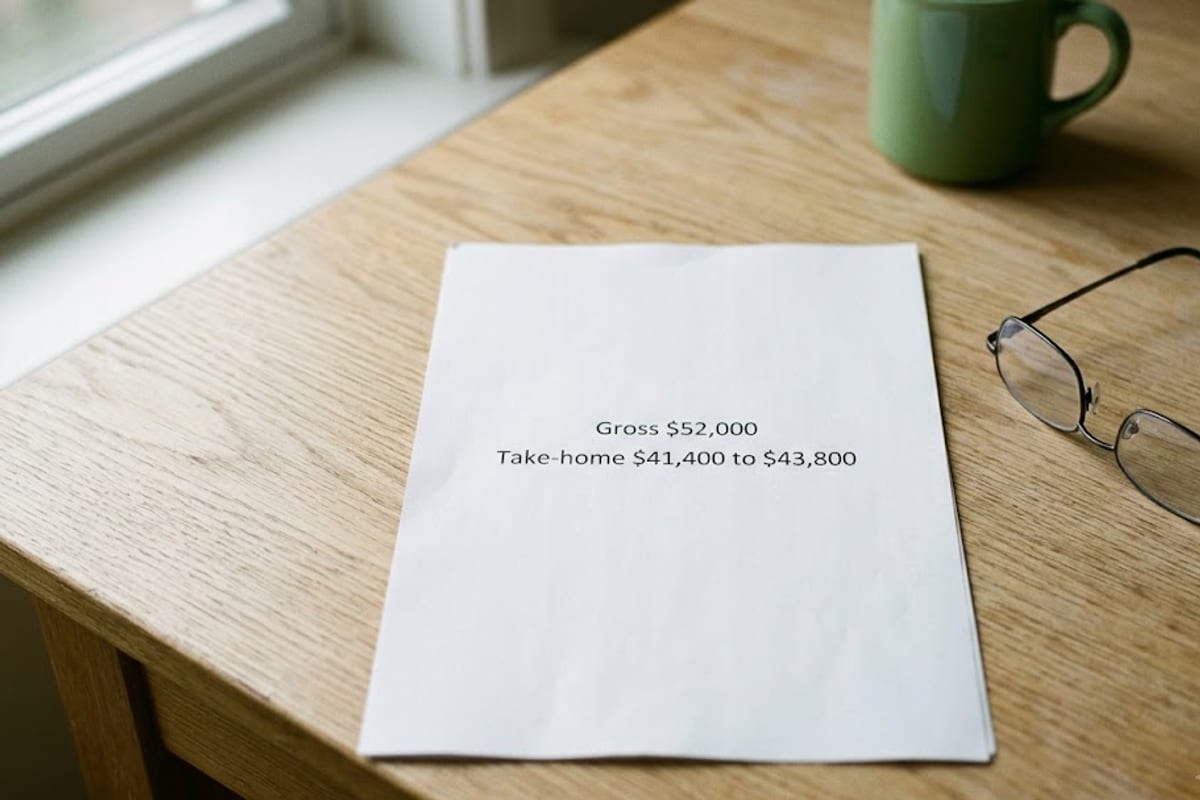
Rough shape for a single filer with no dependants at $52,000, taking the standard deduction:
| Approx. annual | |
|---|---|
| Gross | $52,000 |
| Federal income tax | −$4,200 |
| Social Security (6.2%) | −$3,224 |
| Medicare (1.45%) | −$754 |
| State income tax | −$0 to −$2,600 |
| Take-home | $41,400 to $43,800 |
That is $3,450 to $3,650 a month before any health premium, retirement contribution or other deduction — commonly another $200 to $600 monthly.
Nine states levy no income tax, which is worth up to about $2,600 a year at this income. That is real, and it is usually smaller than the housing difference between the places being compared.
Biweekly, semi-monthly, and the two extra cheques
Payroll frequency does not change annual pay, but it changes what a paycheque looks like and it catches people out.
Biweekly means every two weeks — 26 pay periods, not 24. At $25 an hour that is $2,000 per cheque for 80 hours. Twice a year, a month contains three paydays rather than two, and budgeting monthly against two cheques leaves those two months looking like a windfall when they are simply arithmetic.
Semi-monthly means twice a month — 24 pay periods, on fixed dates. At $52,000 that is $2,167 per cheque, and the hours behind each cheque vary between 80 and 96 depending on the month, which makes hourly employees on this schedule harder to check.
Weekly is 52 cheques of $1,000 at this rate, most common in construction and trades.
Someone paid biweekly who budgets as though there are 24 cheques a year is planning around $48,000 of a $52,000 income. The two extra cheques are the difference, and they are the easiest four thousand dollars a year to save simply because they were never in the monthly plan.
Salaried is not the same as hourly
A salaried job at $52,000 that reliably runs 50 hours a week is $20 an hour, not $25. Exempt salaried employees are not owed overtime, so hours above 40 are unpaid.
Running the conversion backwards on actual hours worked is the only honest way to compare an hourly offer with a salaried one — and it is the comparison most often skipped when the salaried number looks bigger.
Benefits belong in the same comparison: employer health contributions, a retirement match, and paid leave commonly add 20 to 30% of salary in value, and none of it appears in either number.
What the resulting figure is worth depends entirely on where it is spent — the same salary supports very different lives in different metros — and trade rates vary by state on their own logic.