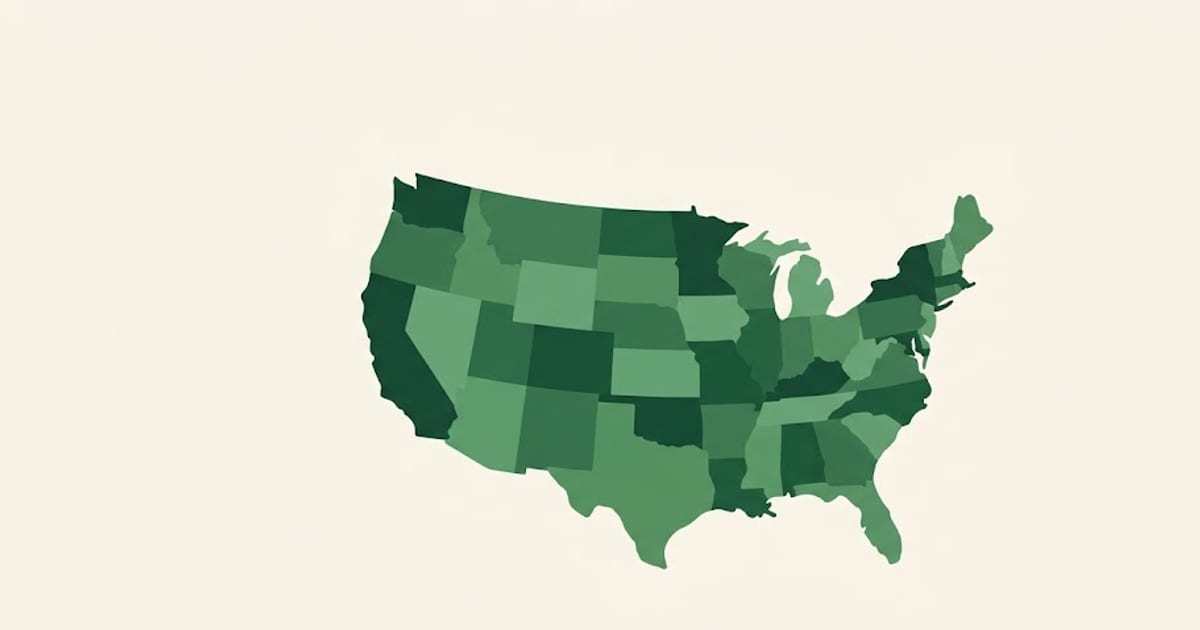
Annual mean wage for heating, air conditioning and refrigeration mechanics and installers, SOC 49-9021.
| State | Annual | Hourly | |
|---|---|---|---|
| 1 | District of Columbia | $84,920 | $40.83 |
| 2 | Alaska | $80,150 | $38.53 |
| 3 | Washington | $78,860 | $37.91 |
| 4 | Massachusetts | $77,760 | $37.38 |
| 5 | New Jersey | $77,580 | $37.30 |
| 6 | Illinois | $77,570 | $37.29 |
| — | United States | $64,780 | $31.14 |
| 47 | Mississippi | $53,020 | $25.49 |
| 48 | West Virginia | $51,700 | $24.86 |
| 49 | Alabama | $51,320 | $24.67 |
| 51 | Arkansas | $51,150 | $24.59 |
The narrowest spread of the twelve trades
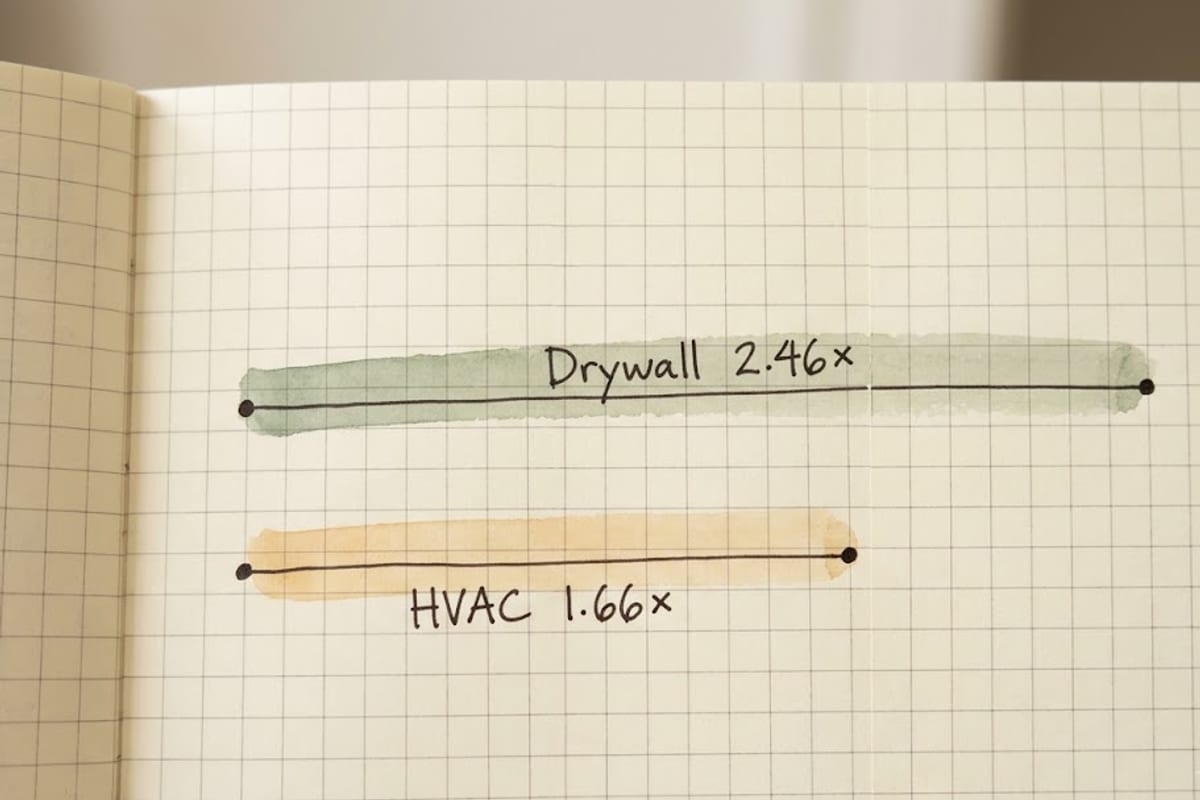
DC pays 66% more than Arkansas. That sounds wide until you compare it:
| Trade | Top-to-bottom ratio |
|---|---|
| Drywall installer | 2.46× |
| Glazier | 2.31× |
| Concrete finisher | 2.30× |
| Plumber | 1.94× |
| Electrician | 1.87× |
| HVAC technician | 1.66× |
Only solar installation is comparably narrow, and that is an artefact of incomplete data rather than a real feature.
Why the range is narrow
Most construction trades live or die on new building, which booms and collapses regionally. When new construction stops in a low-wage state, wages there stay low because there is no competition for labour.
HVAC has a large service and replacement base that exists wherever there are buildings, and it does not follow the construction cycle. A furnace fails in a recession. Equipment reaches end of life on its own schedule. That steady demand puts a floor under the trade even where new-build wages are poor, and the floor is what compresses the range.
It also means HVAC is the trade least exposed to a downturn, which is worth as much as several dollars an hour to anyone thinking about a thirty-year career.
What the top states have in common
Union density and prevailing-wage law, as with every trade here — Washington, Massachusetts, New Jersey and Illinois are all strong on both.
DC at the top is a specific case: a dense commercial building stock, federal and institutional buildings on prevailing wage, and almost no low-wage residential new-build to pull the average down.
Alaska is the other outlier and it is a cost-and-remoteness premium rather than a union one, which is the same reason Alaska tops the concrete finishing table at $100,010.
Two seasons instead of one
Unlike roofers and concrete finishers, HVAC technicians do not lose the winter — they change what they work on. Cooling calls in summer, heating calls in winter, with maintenance contracts and installations filling the shoulder seasons.
That makes annual figures more representative here than in any outdoor trade, where the mean quietly averages in months of no work. Overtime spreads across the year rather than concentrating into one season.
Reading a state figure
It is a mean, not a median, and large commercial and industrial refrigeration employers pull it above what a typical residential service technician earns.
It excludes the self-employed, so contractors running their own vans are missing entirely.
It blends residential comfort work with commercial refrigeration — supermarkets, cold storage, food processing — which pays clearly more and runs on 24-hour call schedules.
EPA 608 certification is the federal gate for handling refrigerant and the only universal requirement in the trade. Several states add a contractor licence on top for anyone running their own work, and those are the states that tend to sit higher on this table.
The full trade ranking and the HVAC trade page carry the rest, and what any of it buys depends on where it is spent.
Source: U.S. Bureau of Labor Statistics, Occupational Employment and Wage Statistics, SOC 49-9021, annual mean wage. Self-employed excluded.