
$20 an hour × 2,080 hours = $41,600 a year.
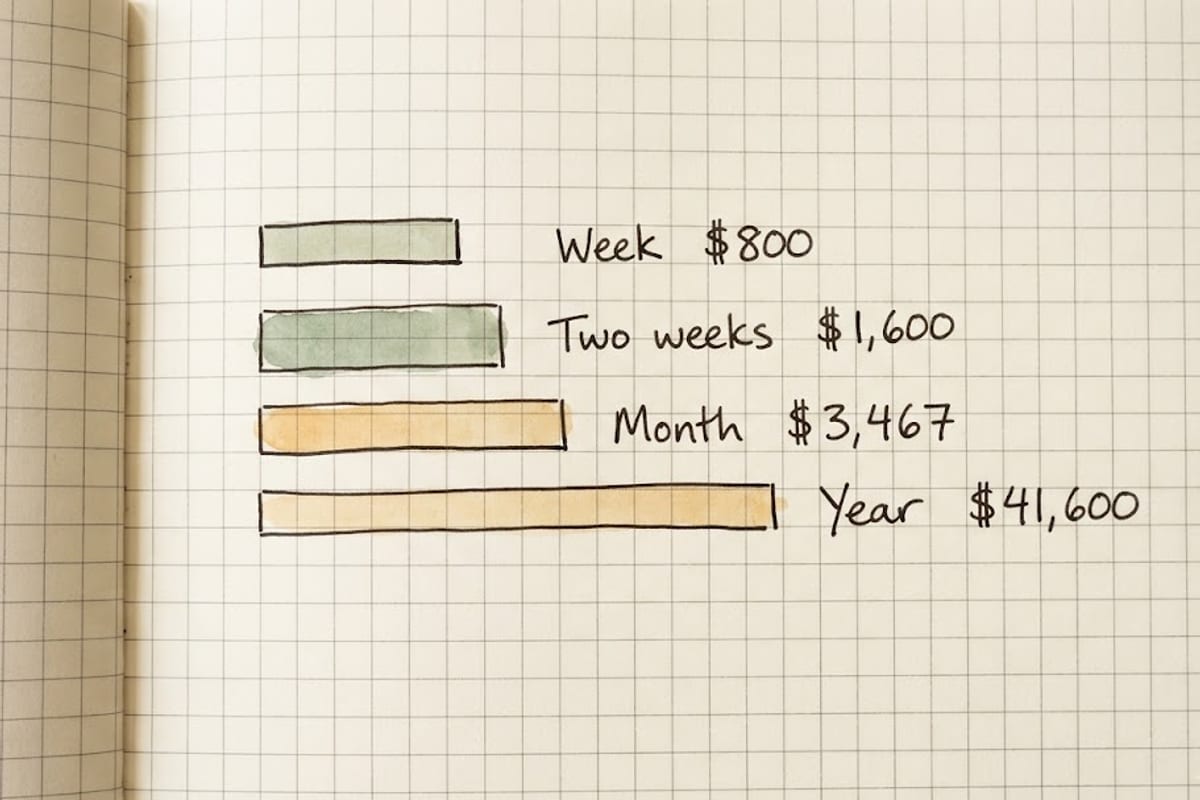
| Per year | $41,600 |
| Per month | $3,467 |
| Per two weeks | $1,600 |
| Per week | $800 |
| Per day (8 h) | $160 |
What actually arrives
Rough shape for a single filer with no dependants taking the standard deduction:
| Annual | |
|---|---|
| Gross | $41,600 |
| Federal income tax | −$2,700 |
| Social Security (6.2%) | −$2,579 |
| Medicare (1.45%) | −$603 |
| State income tax | $0 to −$2,100 |
| Take-home | $33,600 to $35,700 |

That is $2,800 to $2,975 a month before any health premium or retirement contribution, which commonly take another $150 to $450.
Nine states levy no income tax. At this income that is worth up to about $2,100 a year — real money, and usually smaller than the rent difference between the places being compared.
The 2,080 assumption, and when it breaks
Forty hours a week, fifty-two weeks a year. It holds for salaried employees paid through their leave. For an hourly worker without paid time off it does not.
| Situation | Hours | Annual |
|---|---|---|
| Full year, paid leave | 2,080 | $41,600 |
| Two unpaid weeks | 2,000 | $40,000 |
| Four unpaid weeks | 1,920 | $38,400 |
| 45 h/week, 5 at time-and-a-half | 2,340 eq. | $46,800 |
| 30 h/week part-time | 1,560 | $31,200 |
Five overtime hours a week is worth $5,200 a year at this rate — 12.5% more time for 12.5% more base pay plus the half-time premium.
Part-time is where the arithmetic gets harsh: 30 hours a week is not three-quarters of the lifestyle, because rent and utilities do not scale down with hours.
Where $20 an hour sits
It is close to the bottom of the twelve construction trades tracked here. Septic tank servicers average $25.72 an hour nationally and insulation workers $26.32 — the two lowest — so $20 is roughly a first- or second-year apprentice rate in most of them.
That framing matters more than the number. In a trade, $20 an hour is a stage with a defined path out of it: apprentices step up annually and reach journeyman scale in four to five years. Outside a licensed trade, $20 an hour is often just $20 an hour.
What it supports in housing
On the 30% rule, $41,600 gross supports about $1,040 a month in housing.
That is a studio or a shared apartment in most American metros and nothing at all in the expensive ones. Sharing a two-bedroom is the single largest lever available — the same apartment split two ways needs $56,000 per person instead of $112,000 for one, which changes more than any plausible raise would.
Raises, in the units that matter
A dollar an hour is $2,080 a year before tax, or about $1,700 after. That conversion is worth memorising, because raises are offered in one unit and budgeted in the other.
It also reframes what a small raise is worth. Going from $20 to $22 an hour is $4,160 a year — around $340 a month take-home, which is a car payment or a meaningful share of rent. Going from $20 to $20.50 is $85 a month, which mostly disappears.
In the other direction: a job paying $1 an hour more but 20 minutes further away costs roughly 40 minutes a day of unpaid time, which at this rate is worth about $13. The raise wins, but by less than the headline.
Comparing it with a salaried offer
A salaried job at $41,600 that reliably runs 50 hours a week is $16 an hour, not $20. Exempt salaried employees are owed no overtime, so hours past 40 are unpaid.
Run the conversion backwards on actual hours worked before comparing. And put benefits in the comparison — employer health contributions, a retirement match and paid leave commonly add 20 to 30% of salary in value, and none of it appears in either number.
The full conversion table covers other rates, and what the money buys depends entirely on where it is spent.