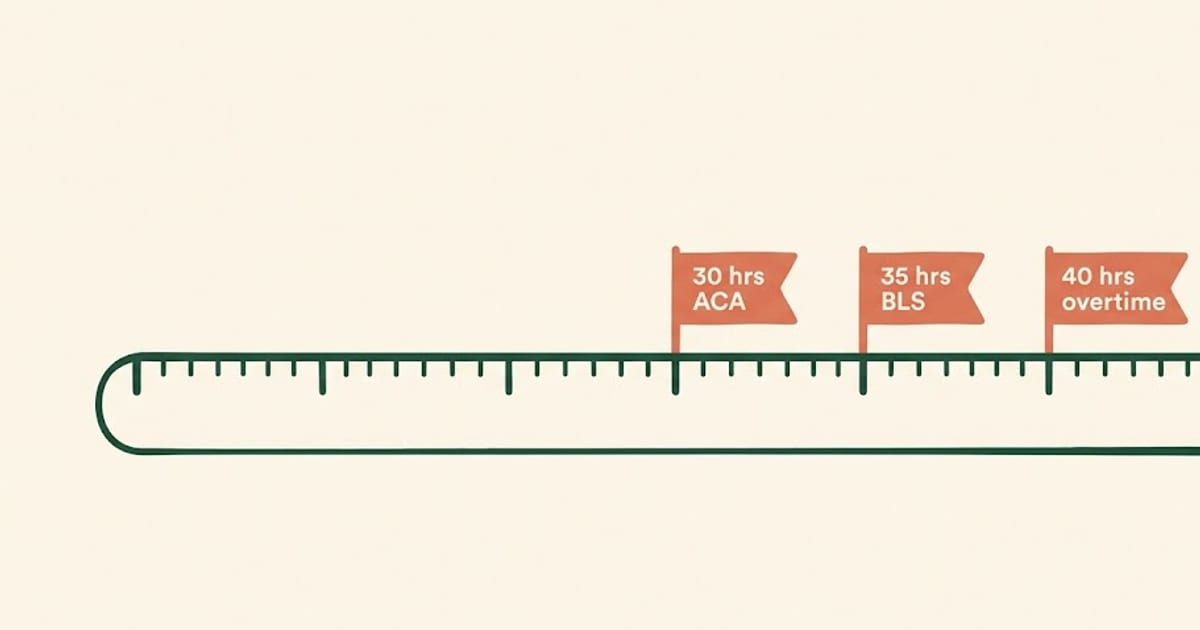
There is no single legal definition of full-time work in the United States. The Fair Labor Standards Act, the main federal wage law, does not define it at all, and the Department of Labor says the question is generally left to the employer. In practice three numbers decide most things:
- 30 hours a week (or 130 hours a month) is full time for health coverage under the Affordable Care Act.
- 35 hours a week is full time in government labor statistics.
- 40 hours a week is the point where federal overtime starts, and the schedule most employers mean when they say full time.
Which one applies to you depends on the question: benefits, statistics, overtime, or your employer's own policy.
The ACA: 30 hours for health coverage
Under the Affordable Care Act, an employer with 50 or more full-time employees (including full-time equivalents) must offer affordable health coverage to its full-time workers or risk a penalty. For this purpose the IRS defines a full-time employee as someone who averages at least 30 hours of service a week, or 130 hours in a calendar month.
Employers with variable-hour staff can use a look-back measurement period of three to twelve months to decide whether someone averaged 30 hours. That is why a worker can drift above 30 hours for a few weeks without immediately becoming eligible, and why some employers cap part-time schedules at 29 hours.
Paid leave counts toward the 30 hours. Hours of service include vacation, holiday and sick time that the employer pays for, not just hours on site.
The BLS: 35 hours for statistics
The Bureau of Labor Statistics classifies anyone who usually works 35 hours or more a week as full time when it reports on the labor force. That is the definition behind headline figures such as the median weekly earnings of full-time workers, which were $1,251 in the second quarter of 2026.
This threshold carries no legal rights. It matters mostly when you compare your pay against published figures: a 32-hour schedule counts as part time in those statistics even if your employer calls it full time.
The FLSA: 40 hours for overtime
The FLSA does not say what full time is, but it does say what happens after 40 hours in a workweek: non-exempt employees must be paid at least one and a half times their regular rate for the excess hours. That makes 40 the practical ceiling of a standard schedule, since every hour above it costs the employer 50% more.
Salaried employees who meet the exemption tests, including a salary of at least $684 a week, are not owed overtime and often work more than 40 hours without extra pay. The details are in how overtime pay is calculated.
What the common schedules are worth
| Weekly hours | Typical schedule | Hours a year | At $20/hr | At $25/hr | At $30/hr |
|---|---|---|---|---|---|
| 30 | Five 6-hour days | 1,560 | $31,200 | $39,000 | $46,800 |
| 32 | Four 8-hour days | 1,664 | $33,280 | $41,600 | $49,920 |
| 35 | Five 7-hour days | 1,820 | $36,400 | $45,500 | $54,600 |
| 37.5 | Five 8-hour days, unpaid lunch | 1,950 | $39,000 | $48,750 | $58,500 |
| 40 | Five 8-hour days | 2,080 | $41,600 | $52,000 | $62,400 |
Figures are hourly rate × weekly hours × 52, before tax. The gap between 30 and 40 hours is a third of annual pay at any rate: at $25 an hour it is $13,000. The exact figures for a schedule are on pages such as $25 an hour at 32 hours a week and $25 an hour at 35 hours a week.
For salaried workers the numbers run the other way. A salary is fixed, so fewer scheduled hours raise the hourly value of the job. $52,000 on a 37.5-hour schedule is $26.67 an hour; on a 40-hour schedule it is $25.00.
Other thresholds that depend on hours
Several benefits use their own hour counts, and none of them is the same as the three above.
Family and Medical Leave Act. To be eligible for FMLA job-protected leave, you must have worked at least 1,250 hours for your employer in the 12 months before the leave starts, along with 12 months of service and a worksite with 50 or more employees nearby. 1,250 hours is about 24 hours a week over a year, so many part-time workers qualify.
Retirement plans. A 401(k) plan may exclude employees who work fewer than 1,000 hours in a year. Since 2025, plans must also let long-term part-time employees contribute once they have worked at least 500 hours in each of two consecutive years, under the SECURE 2.0 Act.
Employer policy. Paid time off, holiday pay, and eligibility for bonuses are usually set by the employer's own definition, which is most often 30, 32 or 40 hours. It will be in the employee handbook or offer letter. If a reduction in hours is on the table, check this definition first, because it is the one most likely to move you from full-time benefits to part-time ones.

How many hours people actually work
The BLS average workweek for all private employees was 34.4 hours in August 2026, which includes part-time workers. In manufacturing, the average was 40.5 hours, including 3.1 hours of overtime. A person working a standard 40-hour week is therefore above the overall average, and a person on 32 hours is below it but not far below.
Over a full year, 40 hours a week comes to 2,080 hours, though the calendar for 2026 holds 2,088 weekday hours and about 2,000 after federal holidays. That breakdown is in how many work hours are in a year.
State rules
A few states set their own definitions for particular programs. State unemployment rules, for example, may let a worker receive partial benefits when hours are cut below a certain level, and state paid leave programs have their own hour or earnings tests. These vary by program rather than setting a general definition of full-time work. Daily overtime is a separate state-level rule: California requires time and a half after 8 hours in a day, so a four-day, 10-hour schedule there costs the employer overtime unless it is set up as an approved alternative workweek.
Frequently asked questions
Is 32 hours full time? For the ACA, yes, since it is above 30. For BLS statistics, no, since it is below 35. For your employer, it depends on the handbook. Four-day, 32-hour schedules are increasingly described as full time by employers that offer them.
Is 36 hours full time? Yes by every common measure except the 40-hour convention. Three 12-hour shifts, common in nursing, add up to 36 hours and are treated as full time by most hospitals.
How many hours is part time? Part time is anything below the full-time threshold being used: under 30 hours for the ACA, under 35 for the BLS.
Do I get overtime if I work over 40 hours as a part-time employee? Yes, if you are non-exempt. Overtime depends on hours worked in the week, not on whether your job is called full or part time.
Sources
- U.S. Department of Labor: "Full-Time Employment" (the FLSA does not define full-time employment); Wage and Hour Division, FMLA eligibility; salary level for exemption ($684 a week, restored May 2026).
- Internal Revenue Service: identifying full-time employees under the employer shared responsibility provisions (30 hours a week, 130 hours a month); 401(k) long-term part-time rules.
- U.S. Bureau of Labor Statistics: Current Population Survey definitions; Usual Weekly Earnings, second quarter 2026; The Employment Situation, August 2026.