
A single person renting alone in Seattle needs roughly $80,000–$90,000. A family of four with one earner needs closer to $130,000–$145,000.
Those are comfort thresholds under the standard rule, not survival ones.
The arithmetic behind it
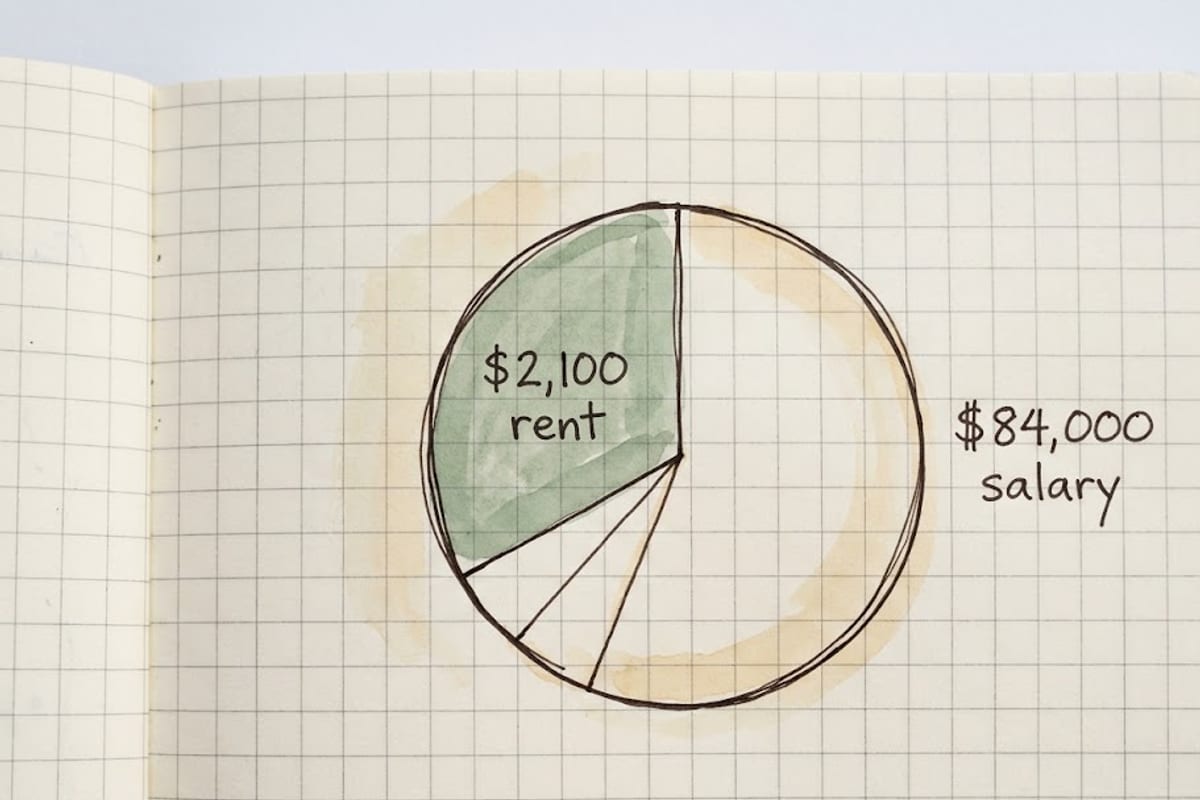
The convention is that housing should take no more than 30% of gross income.
| Household | Typical Seattle rent | × 12 | ÷ 0.30 = salary needed |
|---|---|---|---|
| Studio | $1,700 | $20,400 | $68,000 |
| 1-bed, alone | $2,100 | $25,200 | $84,000 |
| 2-bed, shared (per person) | $1,400 | $16,800 | $56,000 |
| 2-bed, family | $2,800 | $33,600 | $112,000 |
| 3-bed, family | $3,400 | $40,800 | $136,000 |
Sharing is the single largest lever available. The same 2-bed apartment splits to a $56,000 requirement per person instead of $112,000 for one — a bigger effect than any tax or salary difference between cities.
What the rest of the money does
Monthly, for a single person on $85,000 in Seattle:
| Gross | $7,083 |
| Federal tax + FICA | −$1,550 |
| State income tax | −$0 |
| WA Cares + paid leave premiums | −$98 |
| Take-home | ~$5,430 |
| Rent, 1-bed | −$2,100 |
| Utilities, internet, phone | −$260 |
| Groceries | −$500 |
| Transport (transit pass or car) | −$130 to −$650 |
| Health premium | −$150 |
| Left | $1,770 to $2,290 |
Washington levies no state income tax, which at this income is worth roughly $3,500–$4,500 a year against a state charging 5–6%. It does withhold two payroll premiums, 0.58% for the WA Cares long-term care fund and about 0.81% for paid family and medical leave, about $1,180 a year together on $85,000.
That is real money and it is smaller than people expect it to be. It is offset by a state sales tax above 10% in Seattle, and it is dwarfed by the housing line — a $700 monthly rent difference is $8,400 a year, roughly double the entire income tax saving.
Comparing two cities without fooling yourself
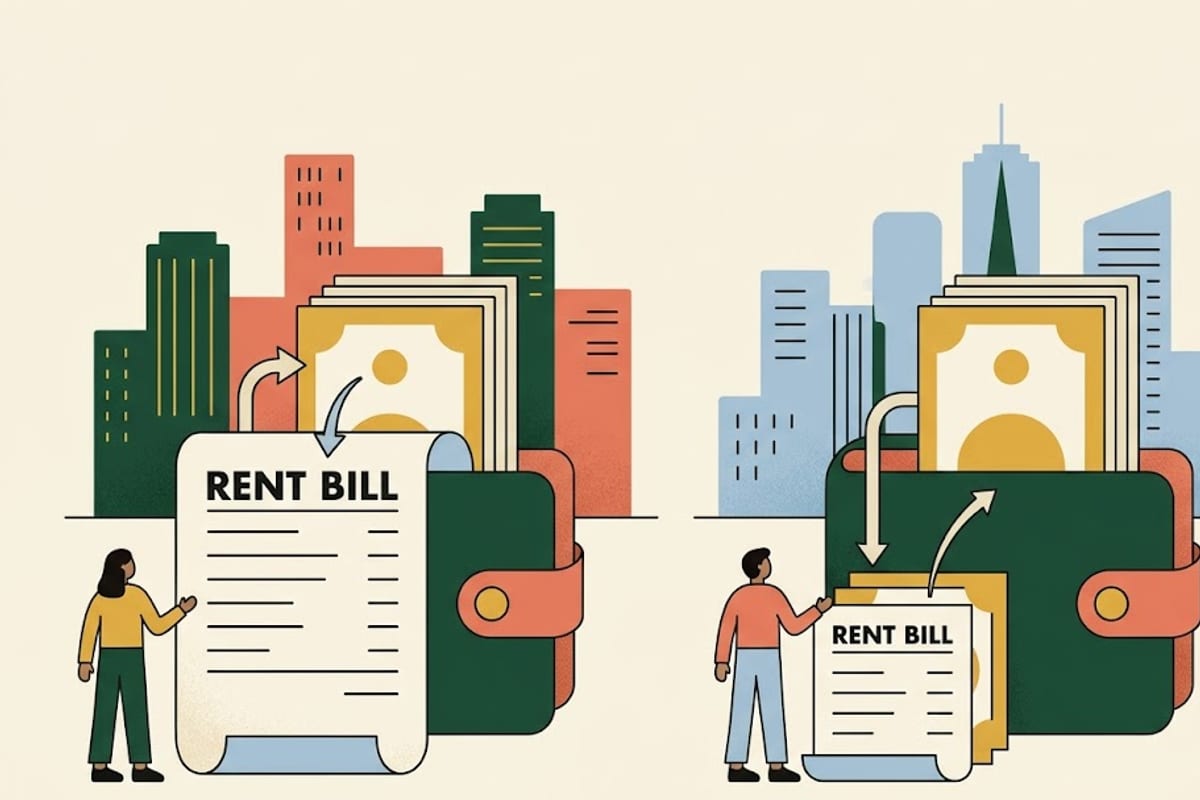
The common mistake is comparing gross salaries. The honest comparison is what is left after housing and tax, because those two lines account for most of the variation between American metros.
(gross − tax) − (annual housing) = the number to compare
An offer of $95,000 in Seattle against $80,000 in a metro with $1,400 rents and a 5% state tax:
| Seattle $95k | Other metro $80k | |
|---|---|---|
| After federal + FICA | $75,700 | $64,900 |
| After state tax | $75,700 | $60,900 |
| After rent | $50,500 | $44,100 |
Seattle wins by about $6,400 here — much less than the $15,000 gap in the offers, and the ranking would reverse if the rent difference were larger or the salary gap smaller.
Groceries, utilities and services vary far less between US metros than housing does, which is why a comparison that gets housing and tax right is usually close enough without pricing anything else.
What the rule does not cover
The 30% guideline predates current housing markets and assumes no unusual debt. Someone carrying a student loan or a car payment is working from a smaller remainder, and lenders will still measure them against a total debt ratio rather than a housing one.
It also says nothing about saving. A budget that fits at exactly 30% housing with nothing left over is a budget with no capacity for a broken car — and in a high-cost metro that gap is where the stress lives, not in the rent itself.
Where a trade rate sits varies by state on its own logic, and the state at the top of a pay table is not automatically the state at the top of this one.