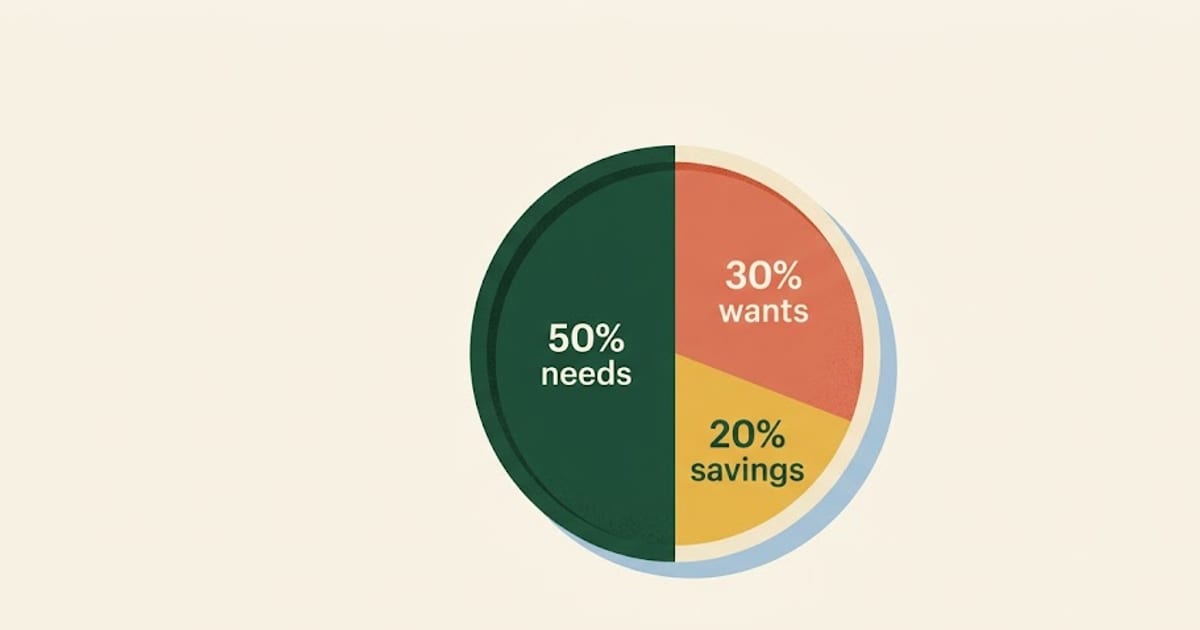
For a single adult, living comfortably takes roughly $56,000 to $86,000 a year before tax, depending on the state. That covers the basic costs estimated by MIT's Living Wage Calculator with 20% of take-home pay left over for savings. Meeting the stricter 50/30/20 standard, where necessities take no more than half of take-home pay, takes about $95,000 in Ohio or Mississippi and $151,200 in California.
Comfortable has no official definition, so this page uses two common ones and shows the salary each requires. Both start from the same list of necessities.
The three levels
Getting by. Take-home pay covers housing, food, transport, health care and other necessities, with nothing left over. This is MIT's living wage, the level covered in what is a livable wage.
Comfortable, modest. Necessities take 80% of take-home pay and the remaining 20% goes to savings: an emergency fund, retirement, a car replacement. There is little room for restaurants or travel, but a job loss or a large bill would not be a crisis.
Comfortable by the 50/30/20 rule. Necessities take 50% of take-home, discretionary spending 30%, and savings 20%. This is the budgeting rule popularized by Senator Elizabeth Warren and Amelia Warren Tyagi in All Your Worth (2005), and it is what most personal finance writers mean by comfortable.
Salary needed for one adult, by state
| State | Basic costs after tax (MIT) | Getting by | Comfortable, modest | Comfortable, 50/30/20 |
|---|---|---|---|---|
| California | $51,416 | $64,800 | $85,700 | $151,200 |
| Massachusetts | $50,697 | $64,100 | $83,100 | $141,900 |
| New York | $49,855 | $62,800 | $81,400 | $140,000 |
| Washington | $46,879 | $55,600 | $70,700 | $120,700 |
| Florida | $42,711 | $50,400 | $63,700 | $108,900 |
| Texas | $38,842 | $45,600 | $57,700 | $97,900 |
| Ohio | $36,886 | $44,200 | $56,000 | $95,400 |
| Mississippi | $36,088 | $44,000 | $55,800 | $95,000 |
How the figures are built: basic costs are MIT's 2026 after-tax budget for one adult with no children in each state. "Getting by" is the gross salary whose 2026 take-home pay equals that budget. "Modest" is the salary whose take-home equals the budget ÷ 0.8. "50/30/20" is the salary whose take-home equals twice the budget. Take-home pay is for a single filer with federal, Social Security, Medicare and state income tax, rounded to the nearest $100. Local income taxes, 401(k) contributions and health premiums are not included.
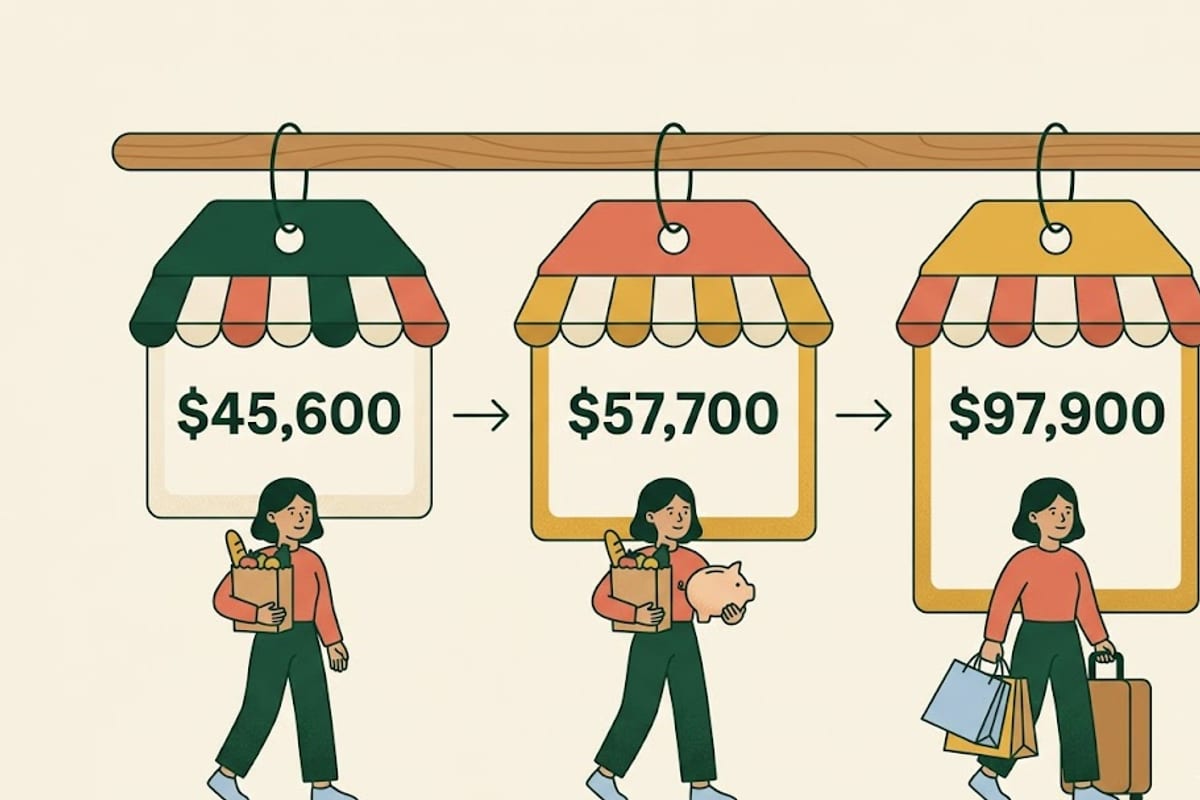
The dashed line in the chart is the median annual earnings of a full-time worker: $1,251 a week in the second quarter of 2026, according to the Bureau of Labor Statistics, or about $65,100 a year. The median worker can live comfortably by the modest standard in every state on the list except California, Massachusetts, New York and Washington. By the 50/30/20 standard, the median worker falls short everywhere.
Why the 50/30/20 figure is so much higher
Doubling the basic budget does not double the salary; it more than doubles it in expensive states. Each extra dollar of take-home costs more than a dollar of salary, because income tax is progressive. In California, going from $85,700 to $151,200 of salary adds $65,500 of gross pay to produce about $38,600 of extra take-home, since most of that increment is taxed at 22% or 24% federally, 9.3% by the state, and 7.65% for payroll taxes.
It also depends on the definition of needs. MIT's budget is spare: it assumes a modest apartment, no car payment beyond typical costs, and meals cooked at home. A person whose rent alone is at the local median, or who carries student loans, will have higher necessities and need a higher salary for the same comfort.
The biggest variable is rent
Housing is the largest item in every state's budget and the one that differs most. MIT's single-adult housing cost is $10,245 a year in Mississippi and $23,383 in California. A common guideline is to keep rent to 30% of gross income; how that works at different salaries, and where it breaks down, is covered in what percentage of income should go to rent.
Because rent varies within states as much as between them, city-level figures can be far from the state average. Detailed breakdowns for two expensive areas are in the salary needed to live in California and the salary needed to live in Seattle.
What it looks like month to month
Take someone in Florida earning $63,700 a year, the modest comfort level. Their take-home pay is about $53,400 a year, or $4,450 a month. MIT's basic budget for Florida is $3,559 a month, leaving about $890 for savings.
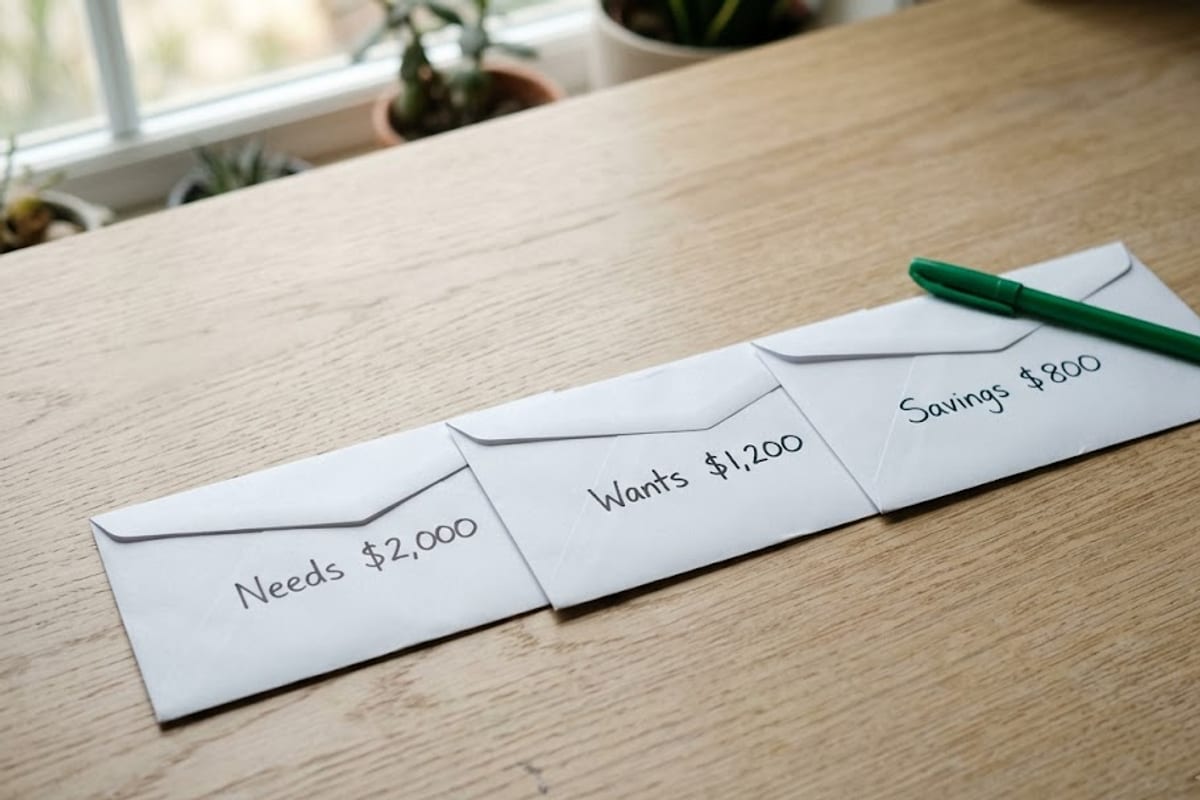
Under the 50/30/20 rule, $4,000 a month of take-home splits into $2,000 for needs, $1,200 for wants and $800 for savings. That is a practical way to test your own budget: add up rent, utilities, groceries, insurance, transport and minimum debt payments, and compare the total with half of your monthly take-home.
Households with more than one person
The figures above are for one adult. Two adults sharing housing need less than twice as much, because rent and utilities are shared. Children add costs faster than any other change: MIT's living wage for one adult with one child is $35.77 an hour in Texas, compared with $21.77 for one adult alone, and in Massachusetts it rises from $30.58 to $58.26, largely because of child care.
For two working adults with two children, MIT's living wage is $24.45 an hour each in Texas and $36.38 each in California. Applying the same 20% savings margin to those figures roughly means household earnings of about $130,000 in Texas and $190,000 or more in California to be comfortable by the modest standard.
How to find your own number
- List your fixed necessities for a month: rent or mortgage, utilities, groceries, insurance, transport, phone, minimum debt payments and any child care.
- Multiply by 12. That is your after-tax budget for necessities.
- Divide by 0.8 for the modest standard, or multiply by 2 for the 50/30/20 standard. That is the take-home pay you need.
- Convert to gross salary using the take-home pages for your state, such as $80,000 after taxes in New York, adjusting up or down until take-home matches your target.
If your current salary is close to the modest figure, the most effective improvements are usually on the housing line rather than the income line.
Frequently asked questions
Is $100,000 enough to live comfortably? For a single adult, yes by the modest standard in every state, and by the 50/30/20 standard in lower-cost states such as Texas, Ohio and Mississippi. In California, New York and Massachusetts, it falls short of the 50/30/20 figure.
Is $60,000 enough to live comfortably? For one adult it meets the modest standard in Texas, Ohio and Mississippi and comes close in Florida. It is slightly below the getting-by level in California, Massachusetts and New York. A detailed look is in is $60K a good salary.
What hourly wage is comfortable? Divide the salary figures by 2,080. The modest standard ranges from about $26.80 an hour in Mississippi to $41.20 in California.
Sources
- MIT Living Wage Calculator, state data updated February 15, 2026 (budgets for one adult, no children; one adult, one child; two working adults, two children).
- U.S. Bureau of Labor Statistics, Usual Weekly Earnings of Wage and Salary Workers, second quarter 2026.
- Elizabeth Warren and Amelia Warren Tyagi, All Your Worth: The Ultimate Lifetime Money Plan (2005), for the 50/30/20 rule.
- Take-home figures from the 2026 federal and state tax calculations on this site (IRS Rev. Proc. 2025-32; SSA 2026 wage base).