$60,000 a year is $28.85 an hour, $1,154 a week, and about $4,199 a month after federal tax, Social Security and Medicare for a single filer in a state with no income tax. In California, New York or Illinois the monthly figure is about $3,955 to $4,000.
It covers a basic cost of living for one adult in 47 of the 51 states and the District of Columbia. The four exceptions are California, Hawaii, Massachusetts and New York. It does not cover a basic budget for a single parent or a one-earner family of four anywhere in the country.
How $60,000 compares
The median full-time worker in the United States earned $1,251 a week in the second quarter of 2026, according to the Bureau of Labor Statistics, which is about $65,050 a year. $60,000 sits a little below that, around the 44th percentile of full-time workers.
Age changes the comparison. BLS puts median weekly pay at $1,160 for full-time workers aged 25 to 34, which is $60,320 a year. For that age group $60,000 is the middle. For workers aged 35 to 44 the median is $1,436 a week, about $74,670, and $60,000 is noticeably below it.
The median across every job in the occupational survey, part-time included, is $24.51 an hour, about $50,980 a year. Against that wider measure, $60,000 is comfortably above the middle.
A household comparison works differently. Census reported a 2025 median household income of $87,460, and many of those households have two earners. A home living on one $60,000 salary is below the household median.
The four states where it is short for one person
The MIT Living Wage Calculator prices a basic budget for each state: fair-market rent, food, health insurance, transportation, phone and internet, and taxes. It does not include savings or discretionary spending. Its before-tax requirement for one adult with no children, from the February 2026 update:
| State | Basic budget, one adult | Left from $60,000 |
|---|---|---|
| Hawaii | $64,504 | −$4,504 |
| Massachusetts | $63,610 | −$3,610 |
| California | $63,402 | −$3,402 |
| New York | $62,167 | −$2,167 |
| New Jersey | $56,884 | $3,116 |
| Washington | $55,316 | $4,684 |
| Colorado | $54,071 | $5,929 |
| Florida | $50,117 | $9,883 |
| Texas | $45,290 | $14,710 |
| Ohio | $43,674 | $16,326 |
In the four short states the gap is between about $2,200 and $4,500 a year, and it comes almost entirely from rent. MIT's monthly housing figure for one adult is $1,949 in California, $1,946 in New York and $1,942 in Massachusetts, against $1,223 in Texas and $906 in Ohio.
Across the middle of the table, $60,000 leaves $3,000 to $10,000 a year above a bare budget. Across the South and Midwest it leaves $10,000 to $17,000, which is enough to save seriously.
A month on $60,000
A single filer on $60,000 with the 2026 standard deduction of $16,100 has $43,900 of taxable income. Federal tax is $1,240 on the first $12,400 and 12% of the next $31,500, which comes to $5,020. Social Security and Medicare take $4,590. That leaves $50,390 a year before any state income tax or state payroll premium.
| State | Take-home per year | Per month |
|---|---|---|
| Texas, Florida | $50,390 | $4,199 |
| Washington | $49,558 | $4,130 |
| Ohio | $49,174 | $4,098 |
| California | $48,021 | $4,002 |
| New York | $47,457 | $3,955 |
| Illinois | $47,565 | $3,964 |
Washington has no income tax, but it withholds two payroll premiums that Texas and Florida do not: 0.58% for the WA Cares long-term care fund and about 0.81% for paid family and medical leave, $832 a year together at this salary. New York adds $290 for disability and paid family leave on top of its income tax. The take-home calculator for $60,000 runs the same figure for every state.
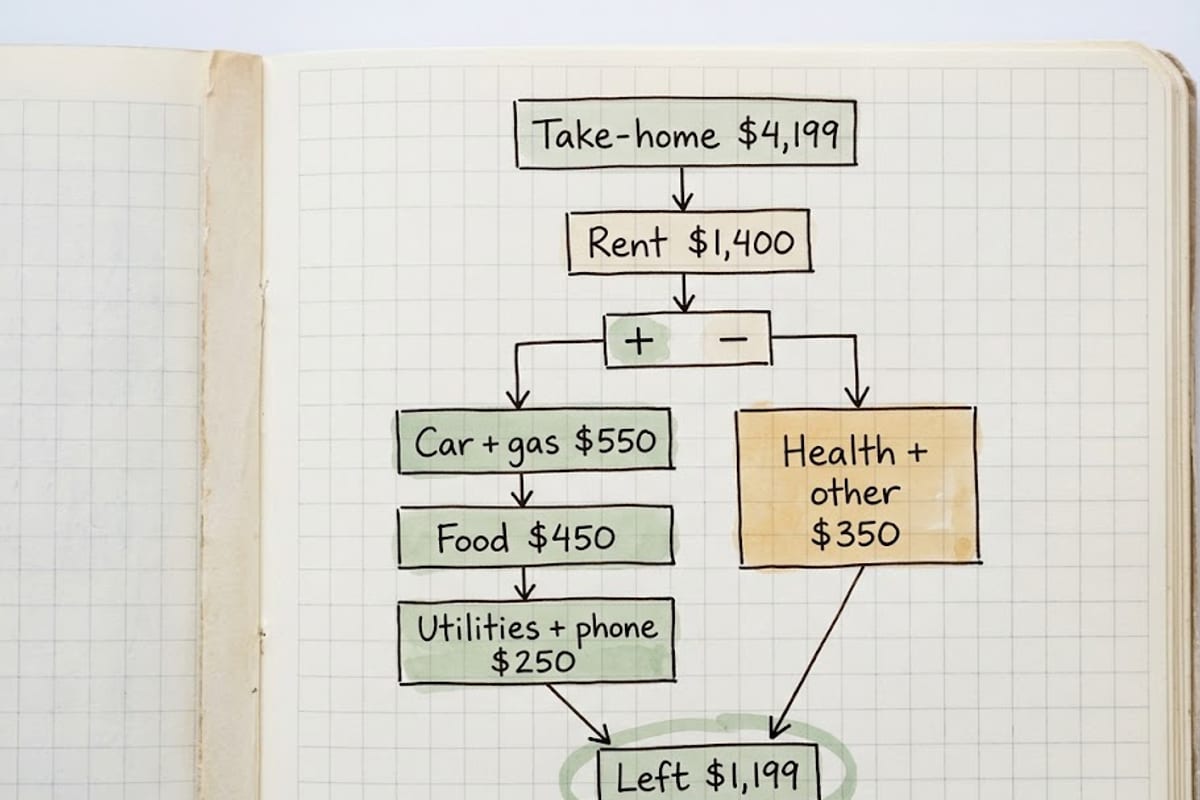
The budget in the notebook uses a $1,400 rent, which is under the $1,500 that the 30% guideline allows on $60,000 gross. With a car payment, food, utilities, health costs and ordinary spending, about $1,200 a month is left. That is enough to build an emergency fund within a year and contribute to retirement at the same time.
Move the same budget to a $1,950 apartment in one of the four expensive states and the remainder falls to about $405 to $450 in California or New York, where take-home is also $200 to $245 a month lower. That is the practical meaning of "short" in the table above: the month still closes, but little is saved.
With a partner and children

MIT's lowest basic budget for one adult with one child is $67,982, in Mississippi. For two adults and two children with one earner the lowest is $74,198, in Arkansas. So $60,000 as the only income in a household with children is below the basic budget in every state.
Two things narrow the gap for real families. The Earned Income Tax Credit and the Child Tax Credit reduce federal tax well below the single-filer figure above, and a married couple filing jointly has a standard deduction of $32,200. A family of four on $60,000 in Texas may owe little or no federal income tax after credits. Those credits help, but childcare is the largest single cost in MIT's family budgets, often more than rent, and a $60,000 income does not absorb it.
When $60,000 is one of two incomes the picture changes. Two earners at $60,000 each bring in $120,000, which covers MIT's two-worker budget for a family of four in 28 of 51 states. In the other 23, including every state in the Northeast and on the West Coast, childcare for two children pushes the basic budget above $120,000.
Buying a home on $60,000
A common lender guideline keeps the full monthly housing payment, including property tax and insurance, at or below 28% of gross income. On $60,000 that is $1,400 a month.
At the 7.03% average rate for a 30-year fixed loan that Freddie Mac reported for September 24, 2026, with 10% down and about 1.6% of the home's value a year for tax and insurance, $1,400 a month supports a price of roughly $191,000.
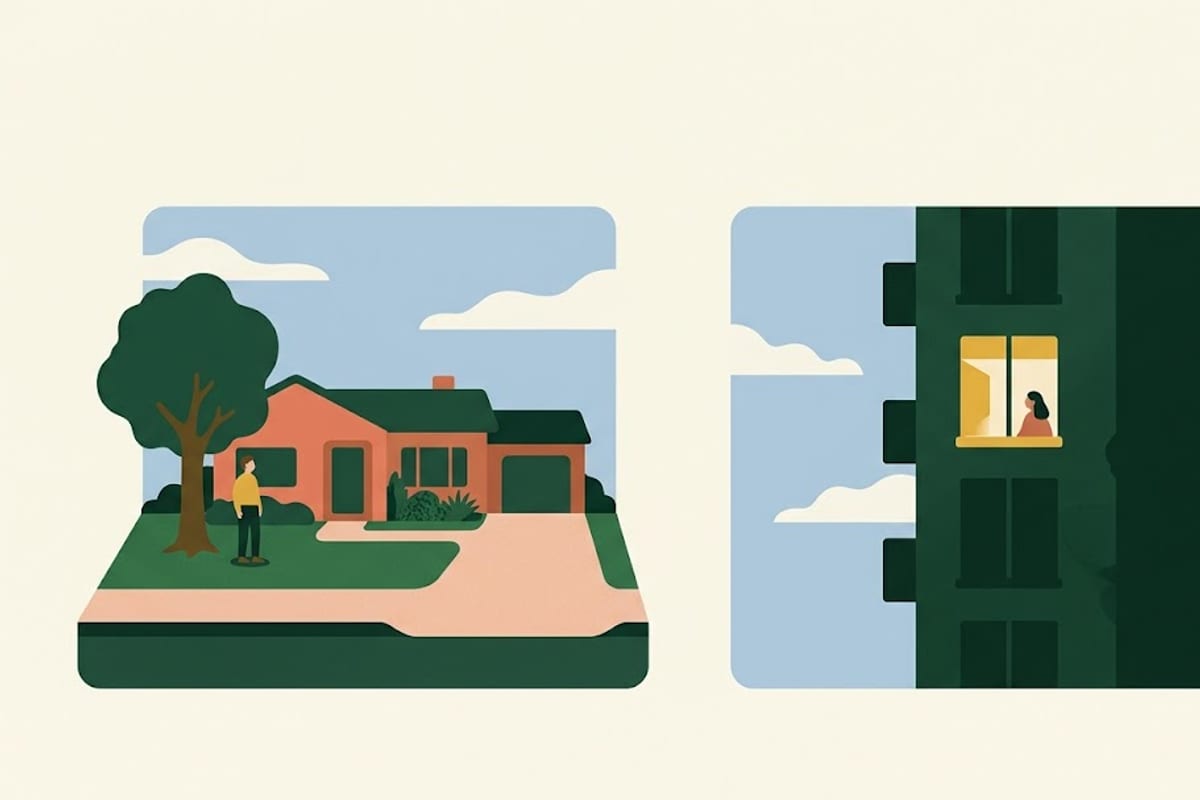
That buys a small house in many Midwestern and Southern cities. In most coastal metros it buys a studio condominium or nothing. Property tax rates differ several times over between states, and a state with high property tax will push the affordable price well below $191,000.
Against common jobs
These are the May 2025 BLS median wages for some large occupations, with the annual figure at 2,080 hours.
| Occupation | Median hourly | About per year |
|---|---|---|
| Customer service representatives | $21.53 | $44,780 |
| Construction laborers | $22.66 | $47,130 |
| Welders, cutters, solderers | $25.84 | $53,750 |
| Heavy and tractor-trailer truck drivers | $28.19 | $58,640 |
| Carpenters | $29.12 | $60,570 |
| Electricians | $30.38 | $63,190 |
| Plumbers, pipefitters, steamfitters | $30.67 | $63,790 |
| Registered nurses | $46.90 | $97,550 |
An offer of $60,000 is a normal median wage for carpenters and truck drivers, a little under the median for electricians and plumbers, and well above it for customer service or general labor. Pay for the same trade also varies by state, so the state figure for the occupation is the better benchmark when one is available.
Where it usually goes next
For most full-time workers pay rises fastest between the late twenties and the early forties. The BLS medians above move from $1,160 a week for ages 25 to 34 to $1,436 a week for ages 35 to 44, an increase of about 24%. A $60,000 salary that follows that curve reaches roughly $74,000 in a decade before any promotion. One that stays flat loses ground every year to rent and prices.
That is why the same salary reads differently at different points in a career. At 27 in Ohio, $60,000 is a solid start with room to save. At 42 in California with two children, it is the reason a second income or a move is on the table. The California cost-of-living breakdown shows what the higher-cost end of that range requires, and is $50K a good salary runs the same state test one step down.
Saving on it
The long-standing rule of thumb puts 20% of gross toward savings and retirement. On $60,000 that is $1,000 a month. It is realistic where rent is near $1,200 and hard where rent is near $1,900.
Order matters more than the percentage. First, an emergency fund of one month's spending. Second, any employer 401(k) match in full: a 4% match on $60,000 is $2,400 a year, and it is lost if the employee does not contribute. Third, a larger emergency fund of three months. Only after that, extra retirement saving.
Frequently asked questions
Is $60,000 a good salary for a single person? Yes in 47 of 51 states: it covers a basic budget with money left over. In California, Hawaii, Massachusetts and New York it covers a basic budget only with a roommate or a below-market rent.
How much is $60,000 an hour? $28.85 at 40 hours a week. At 45 hours a week of salaried work it is $25.64 an hour; the hourly calculator shows the conversion for other schedules.
Is $60,000 middle class? For one person it is in the middle band of full-time earners. For a household it is below the 2025 median household income of $87,460.
What rent can I afford on $60,000? About $1,500 a month under the 30% guideline, which is 36% of take-home pay in a no-income-tax state. $1,200 to $1,400 leaves room to save; above $1,700 saving becomes difficult. The rent guide covers the other rules lenders and landlords use.
Sources
- Bureau of Labor Statistics, Usual Weekly Earnings of Wage and Salary Workers, Second Quarter 2026, Tables 3 and 5.
- Bureau of Labor Statistics, Occupational Employment and Wage Statistics, May 2025, Table 1.
- US Census Bureau, Income in the United States: 2025, released September 15, 2026.
- MIT Living Wage Calculator, state data updated February 15, 2026.
- IRS Revenue Procedure 2025-32.
- Freddie Mac Primary Mortgage Market Survey, September 24, 2026.