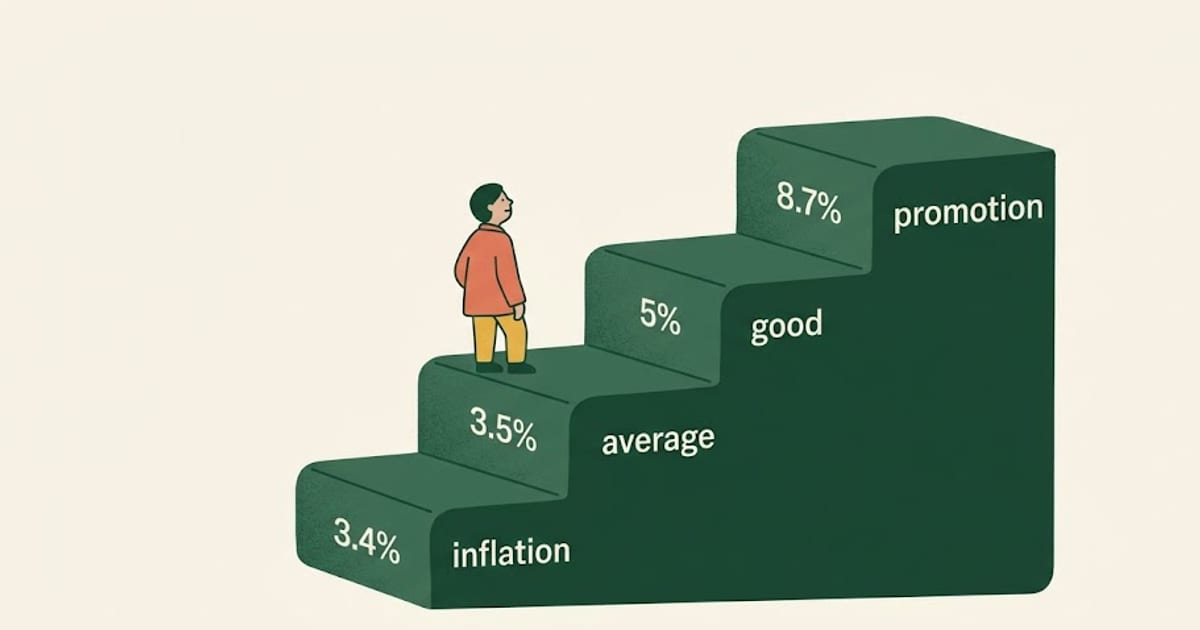
A good raise in 2026 is anything above about 4%. The average raise employers budgeted for 2026 is 3.5% in total and 3.2% for merit alone, according to Mercer's survey of more than 1,000 U.S. organizations. Over the same period, consumer prices rose 3.4% in the 12 months to August 2026, according to the Bureau of Labor Statistics. A 3% raise this year therefore buys slightly less than last year's pay did.
In practice the ranges look like this:
- Under 3%: below average, and below inflation. Pay is falling in real terms.
- 3% to 4%: the normal annual raise. Roughly keeps pace with prices.
- 5% to 7%: above average, typically for strong performance or a scarce skill.
- 8% to 10% or more: promotion territory. Mercer found promotion raises average 8.7%.
- Larger jumps: most often come with a change of employer.
What employers are actually paying
Salary budgets have been stable for three years after the sharp increases of 2021 to 2023.
| Survey | Year | Figure |
|---|---|---|
| Mercer QuickPulse (Dec. 2025) | 2026 planned | 3.2% merit, 3.5% total |
| Mercer | 2026 planned | promotions average 8.7%; about 9% of staff promoted |
| WTW Salary Budget Planning (July 2026) | 2026 actual | 3.5% |
| WTW Salary Budget Planning (July 2026) | 2027 planned | 3.4% |
"Total" includes merit, promotion, market and cost-of-living adjustments, so the average person who is not promoted sees something closer to the merit figure.
Budgets are averages across a whole workforce. Within one company, top-rated employees typically receive well above the budget and lower-rated employees below it, so a 3.2% average can mean 5% for some people and 1% or nothing for others.
A raise measured against inflation
A raise only improves your standard of living by the amount it exceeds price growth. With the CPI at 3.4% over the latest 12 months:
| Raise | Real change in buying power |
|---|---|
| 2% | −1.35% |
| 3% | −0.39% |
| 3.5% | +0.10% |
| 4% | +0.58% |
| 5% | +1.55% |
| 7% | +3.48% |
| 10% | +6.38% |
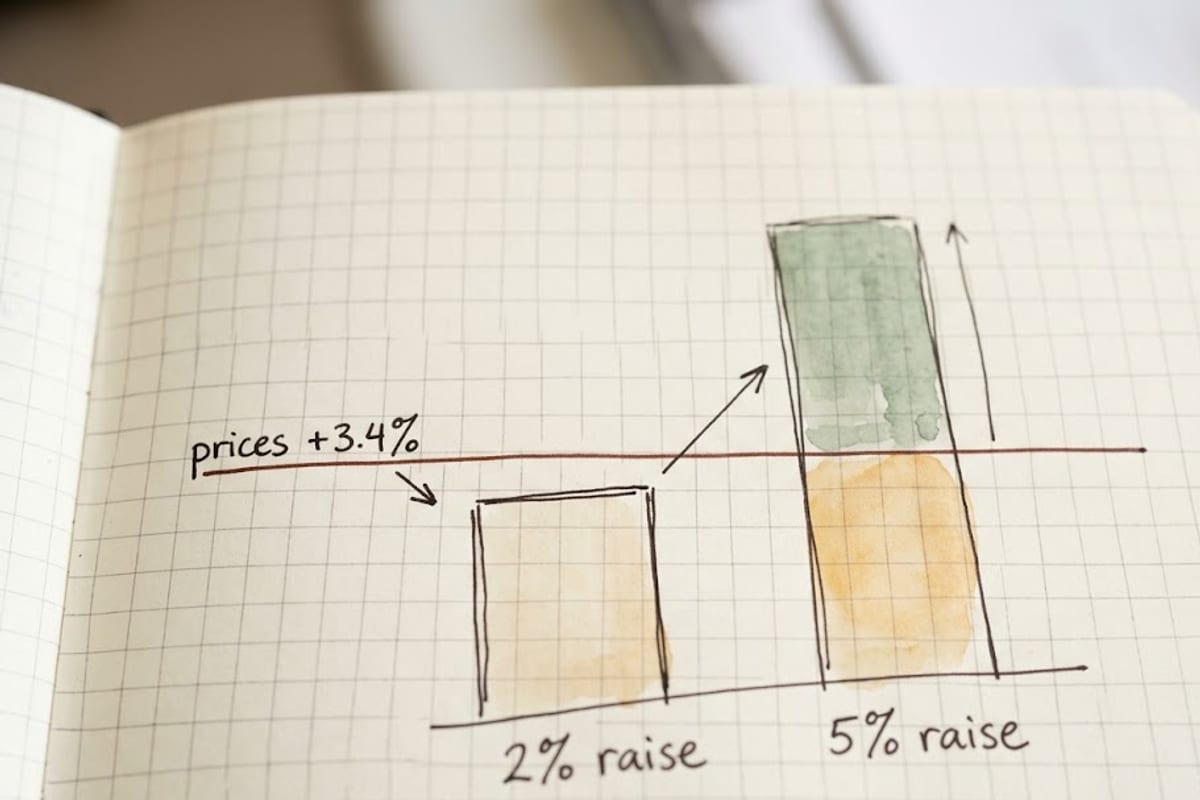
The real change is (1 + raise) ÷ (1 + inflation) − 1. It is close to raise minus inflation for small numbers, and the exact version is slightly lower. For comparison, Social Security benefits rose 2.8% in January 2026 under the annual cost-of-living adjustment, which is based on a different price index.
Inflation affects people differently. The shelter index rose 3.0% over the year to August, below the headline rate, while other categories rose faster. If your largest costs are rent and a car, your personal inflation rate may differ from the CPI by a point or more either way.
What a raise adds to each paycheck
Raises are quoted before tax, but they arrive after it. The whole raise is taxed at your top federal bracket, plus 7.65% for Social Security and Medicare, plus any state tax.
| Salary | 3% raise, before tax | 3% after federal tax and FICA | Per biweekly check | 5% after tax | Per check |
|---|---|---|---|---|---|
| $45,000 | $1,350 | $1,085 | +$42 | $1,808 | +$70 |
| $60,000 | $1,800 | $1,446 | +$56 | $2,411 | +$93 |
| $75,000 | $2,250 | $1,583 | +$61 | $2,638 | +$101 |
| $100,000 | $3,000 | $2,111 | +$81 | $3,518 | +$135 |
A single filer on $60,000 is in the 12% federal bracket and keeps about 80 cents of each raise dollar before state tax. At $75,000 the top bracket is 22%, and the share kept falls to about 70 cents. That is why a 3% raise on $75,000 adds only a few dollars more per check than a 3% raise on $60,000, even though it is $450 larger before tax. Each figure comes from the raise calculator, for example a 5% raise on $75,000 and a 3% raise on $100,000.
Why small differences compound
Raises build on each other. A $60,000 salary that rises 3% a year for ten years reaches $80,635. At 5% a year it reaches $97,734. The gap after a decade is $17,099 a year, from a difference of two percentage points. This is the reason negotiating the size of a raise is worth more than negotiating a one-time bonus of the same amount: the bonus is paid once, and the raise is part of every future year's base.
Merit raises, cost-of-living adjustments and market adjustments
Employers use three kinds of increase, and they are often combined into one number on a raise letter.
A merit increase rewards individual performance and comes out of the merit budget, 3.2% on average in 2026. A cost-of-living adjustment gives everyone the same percentage to offset inflation; it is standard in many union contracts and government pay scales, and less common in private companies. A market adjustment brings a role up to the going rate when the employer finds it has fallen behind, and it is usually given outside the annual cycle.
If you receive 4%, it is worth asking how it breaks down. A 4% merit raise means you were rated above average. A 2% merit raise plus a 2% company-wide adjustment means you were rated below average in a year when everyone received something. The total is the same today, but the rating will shape future raises.
Staying versus switching jobs
The Federal Reserve Bank of Atlanta tracks the median wage growth of individual workers observed a year apart. In July 2026 it stood at 3.8% overall: 3.6% for people who stayed in the same job and 4.4% for people who changed jobs. The gap between the two has been narrower in 2025 and 2026 than it was in 2022, when switchers were well ahead, but it has not closed.

The Atlanta Fed figures are medians, so half of job changers did better than 4.4% and half did worse. The difference compounds: over five years, 3.6% a year takes $60,000 to $71,606, and 4.4% a year takes it to $74,414.
Judging your own raise
Before deciding whether a raise is good, compare it with four things:
- Inflation over the last 12 months. 3.4% as of August 2026. Below that, your pay fell in real terms.
- Your company's budget. HR will often say what the merit budget was. A raise above the budget means you were rated above average.
- The market rate for your job. If similar roles pay 10% more elsewhere, a 4% raise still leaves you behind. The occupation pages on this site, such as how much electricians make, show where median and top pay sit for common trades.
- What it does to your take-home. A raise that moves you into a higher bracket, or out of eligibility for a credit, can be worth less than it looks. The raise calculator shows the after-tax effect for any salary from $25,000 to $200,000.
If the raise falls short, the most effective argument is usually evidence of market pay for your role and a record of the specific results you delivered, presented before budgets are set rather than after.
Frequently asked questions
Is a 3% raise good? It is average for 2026 and slightly below the 3.4% inflation rate, so it roughly maintains your pay without improving it.
Is a 5% raise good? Yes. It is about 1.5 points above both the average raise and inflation.
Is a 10% raise good? Yes, it is well above any normal merit increase and above the 8.7% average for a promotion.
How much should I ask for in a raise? Something between the company's budget and the market gap for your role. If you are paid at market, 4% to 6% is a reasonable request in 2026. If you are well below market, the gap itself is the figure to ask for.
Sources
- Mercer, "Most US employers plan to keep 2026 salary increases flat to 2025" (Dec. 9, 2025), QuickPulse US Compensation Planning Survey.
- WTW, Salary Budget Planning Report (July 2026).
- U.S. Bureau of Labor Statistics, Consumer Price Index, August 2026.
- Federal Reserve Bank of Atlanta, Wage Growth Tracker, July 2026.
- Social Security Administration, 2026 cost-of-living adjustment (2.8%).
- Internal Revenue Service, Rev. Proc. 2025-32 (2026 brackets).