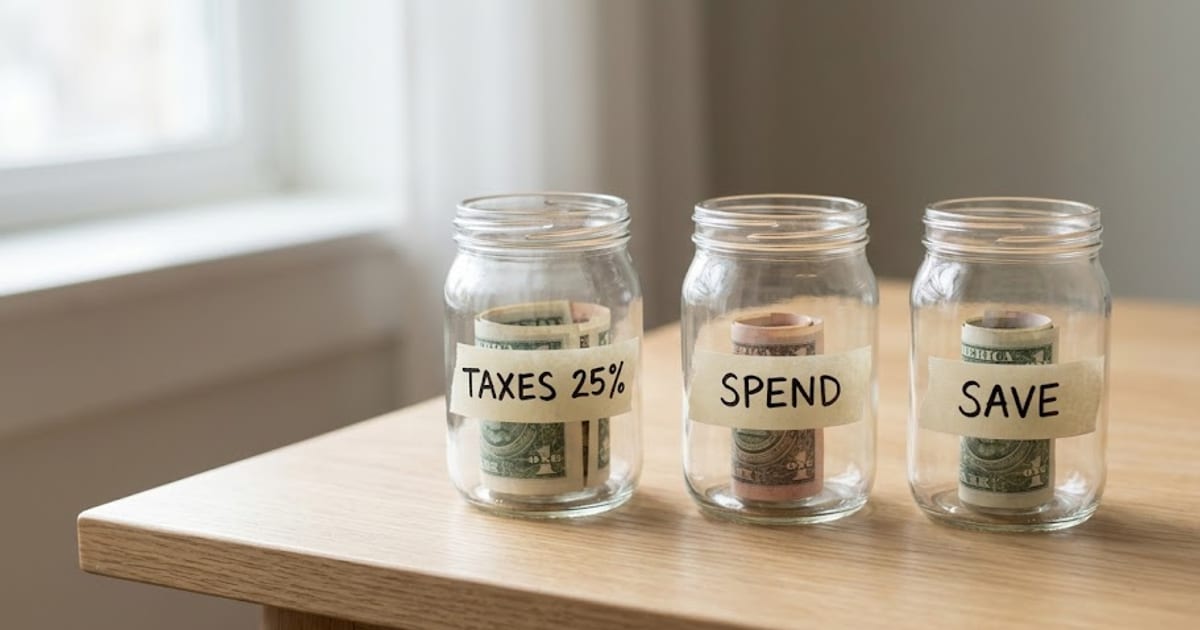
If you are paid without tax withheld, set aside about 20% of your net self-employment income for federal tax, then add your state's income tax rate. On $50,000 of net profit in 2026, a single filer owes about $9,732 in federal tax, or 19.5%. At $100,000 the share rises to 22.4%. The common advice to save 25% to 30% covers federal and state together at middle incomes and leaves a small cushion.
The reason the number is higher than people expect is self-employment tax. An employee pays 7.65% for Social Security and Medicare and the employer pays the other 7.65%. When you are self-employed, you pay both halves: 15.3%, starting from your first dollar of profit.
How much to set aside, by income
| Net self-employment income | Self-employment tax | Federal income tax | Total federal | Share of income | Each quarterly payment |
|---|---|---|---|---|---|
| $20,000 | $2,826 | $199 | $3,025 | 15.1% | $756 |
| $30,000 | $4,239 | $942 | $5,181 | 17.3% | $1,295 |
| $40,000 | $5,652 | $1,775 | $7,427 | 18.6% | $1,857 |
| $50,000 | $7,065 | $2,667 | $9,732 | 19.5% | $2,433 |
| $60,000 | $8,478 | $3,559 | $12,037 | 20.1% | $3,009 |
| $75,000 | $10,597 | $4,898 | $15,495 | 20.7% | $3,874 |
| $100,000 | $14,130 | $8,235 | $22,365 | 22.4% | $5,591 |
| $150,000 | $21,194 | $16,413 | $37,608 | 25.1% | $9,402 |
Single filer, 2026 tax year, no other income. Self-employment tax is 15.3% of 92.35% of net profit. Income tax uses the $16,100 standard deduction, the deduction for half of self-employment tax, and the 20% qualified business income deduction, which the 2025 tax law made permanent. State income tax is not included.
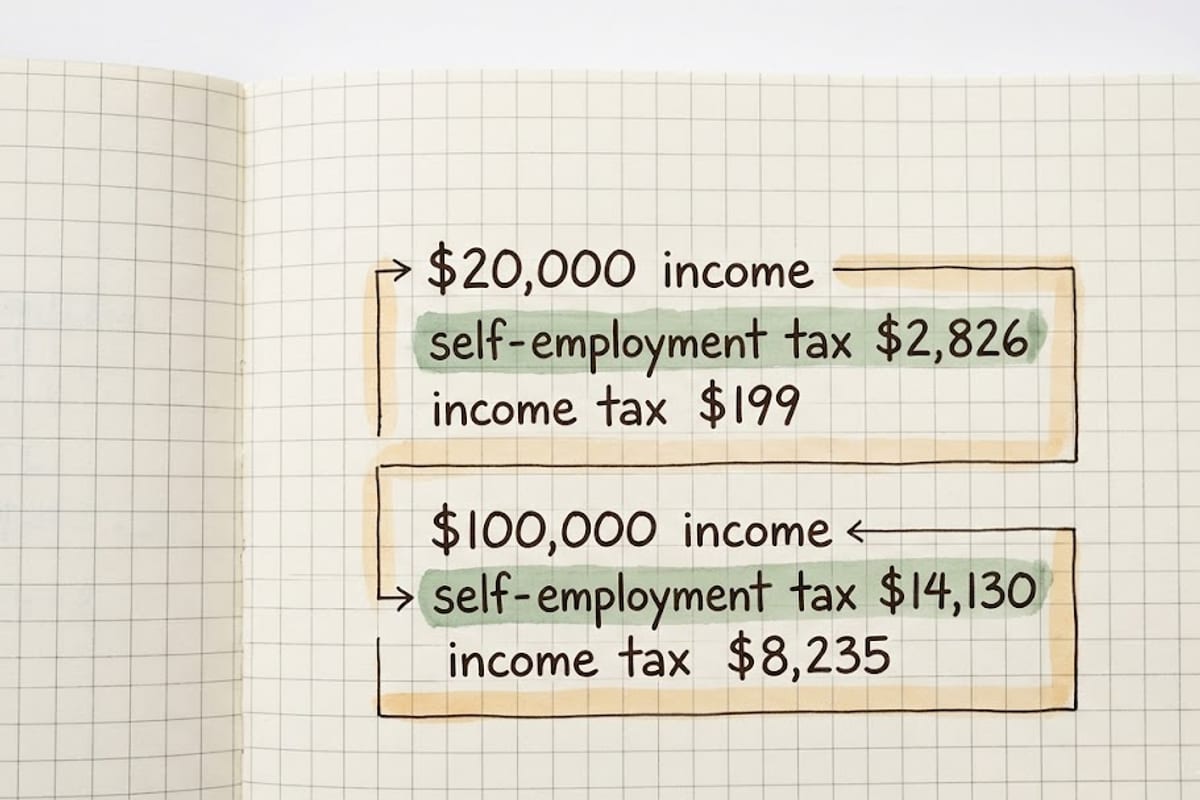
At lower incomes almost all of the bill is self-employment tax. At $20,000 of profit, income tax is under $200 after the standard deduction, but self-employment tax is $2,826. People who assume they owe little because their income is low are often caught out by this.
Adding state tax
State income tax rates on middle incomes range from zero in the nine states without a wage income tax to 6% or more at the margin in the highest-tax states. The simplest safe approach is to add your state's marginal rate on your income to the federal share in the table. That overstates the bill a little, because the lower state brackets and deductions pull the effective rate down, and the excess comes back as a refund. In Ohio, where the 2026 schedule charges $332 plus 2.75% on taxable income above $26,050, the effective addition at $50,000 of profit is about 1.7 points. In California, $50,000 of taxable income falls in the 6% bracket, but the effective state rate is closer to 3%.
Some cities also tax self-employment income. New York City, Philadelphia and many Ohio municipalities do, which can add another 2% to 4%.
The four due dates
The IRS expects tax to be paid as income is earned. For self-employed people that means quarterly estimated payments on Form 1040-ES. The 2026 due dates are:
- April 15, 2026 for income earned January through March
- June 15, 2026 for April and May
- September 15, 2026 for June through August
- January 15, 2027 for September through December
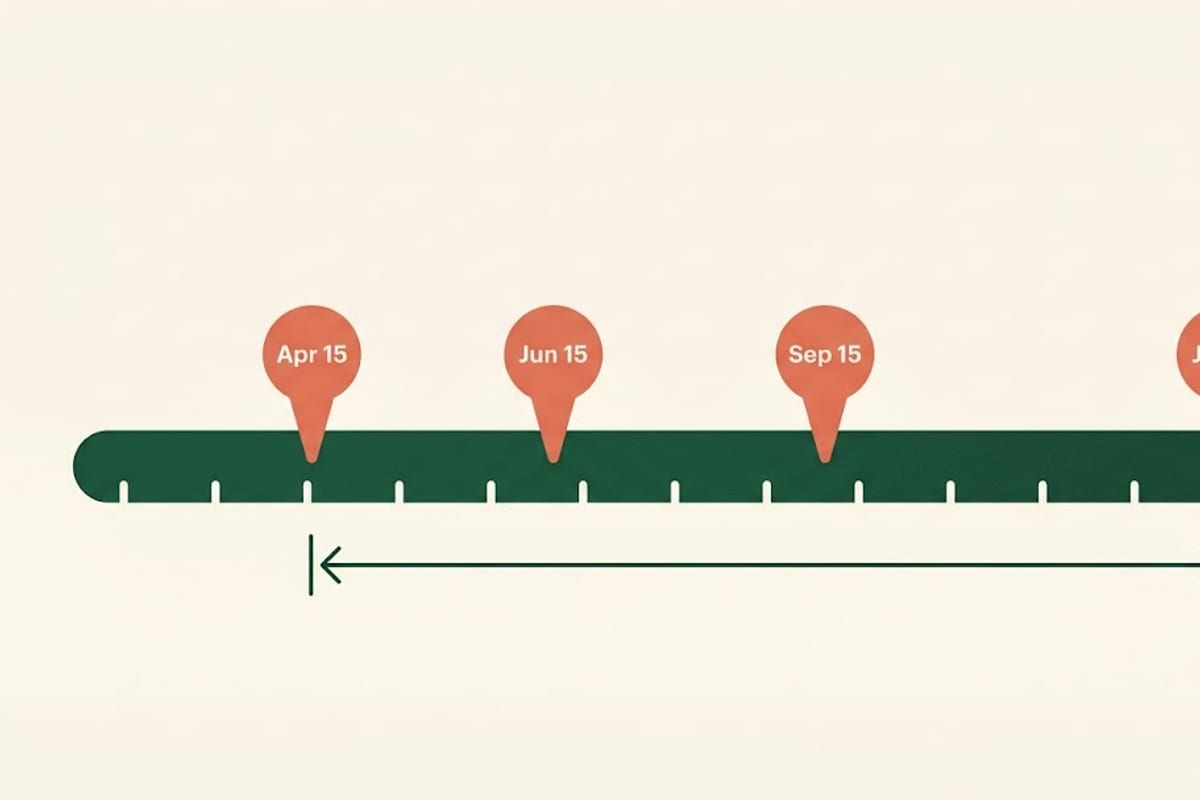
The quarters are not equal. The second covers two months and the fourth covers four. If your income is lumpy, you can pay based on what you actually earned in each period using the annualized income method, which avoids overpaying early in the year.
Avoiding the underpayment penalty
You will not owe an underpayment penalty if your withholding and estimated payments for the year add up to at least the smaller of:
- 90% of this year's tax, or
- 100% of last year's tax, rising to 110% if last year's adjusted gross income was over $150,000.
The prior-year rule is the easiest to use when your income is growing. Take last year's total tax, divide by four, and pay that each quarter. You may owe more in April, but you will not owe a penalty. If your income is falling, the 90% rule based on this year's estimate lets you pay less.
A practical routine
- Open a separate savings account used only for taxes.
- Move a fixed percentage of every payment into it the day it arrives. Use the figure from the table for your expected income plus your state rate, rounded up to the nearest 5%.
- Pay the quarterly estimate from that account on each due date, through IRS Direct Pay or your IRS online account.
- Recheck the percentage in June and September against your year-to-date profit. If income is running ahead of plan, raise the percentage for the rest of the year.
Holding the money in a high-yield savings account earns interest on it for the months before each payment is due.
If you also have a W-2 job
A side business on top of a salary is taxed at your highest bracket, because the salary has already used up the lower brackets. A single filer earning a $60,000 salary who adds $10,000 of freelance profit owes about $1,413 in self-employment tax and roughly $892 in federal income tax on it, a total of 23% of the side income, before state tax.
You can handle this without quarterly payments by increasing withholding at your day job. Step 4(c) of Form W-4 lets you ask your employer to withhold an extra fixed amount from each paycheck. $2,305 spread over 26 biweekly checks is about $89 a check. Withholding counts as paid evenly through the year for penalty purposes, even if you increase it late in the year.
When W-2 employees need to save
For most employees, withholding covers the tax and there is nothing to set aside. The exceptions are:
- Two jobs, or two working spouses, with W-4s that were not adjusted. Each employer withholds as if its paycheck were the only income, which under-withholds. The fix is Step 2 of the W-4.
- Large bonuses taxed at the flat 22% supplemental rate when your actual bracket is 24% or higher.
- Investment income, such as interest, dividends and capital gains, which has no withholding.
- Unemployment benefits, where withholding is optional at 10%.
The breakdown of what comes out of a regular paycheck is in why your paycheck is less than expected, and take-home pay for a salary in each state is on pages such as $60,000 after taxes in Texas.
Frequently asked questions
How much should I save for taxes as a 1099 worker? About 15% to 25% of net profit for federal tax depending on income, plus your state rate. 25% to 30% of net profit is a reasonable round figure for most people.
Is it based on gross or net income? Net. Business expenses such as mileage, equipment and software reduce the profit that both taxes apply to. Keep records of every expense, because each dollar of expense saves roughly 20 to 35 cents of tax.
What if I miss a quarterly payment? Pay as soon as you can. The penalty works like interest on the late amount for the time it was late, so a payment a few weeks late costs little.
Do I pay self-employment tax if I earn under $400? No. Self-employment tax applies only when net earnings from self-employment are $400 or more for the year.
Sources
- Internal Revenue Service: Rev. Proc. 2025-32 (2026 brackets and standard deduction); 2026 Form 1040-ES instructions (due dates, safe harbor); Self-Employment Tax (Social Security and Medicare Taxes); Publication 15 (supplemental wage withholding).
- Social Security Administration: 2026 contribution and benefit base, $184,500.
- Tax Foundation and IRS guidance on the qualified business income deduction under the 2025 tax law.