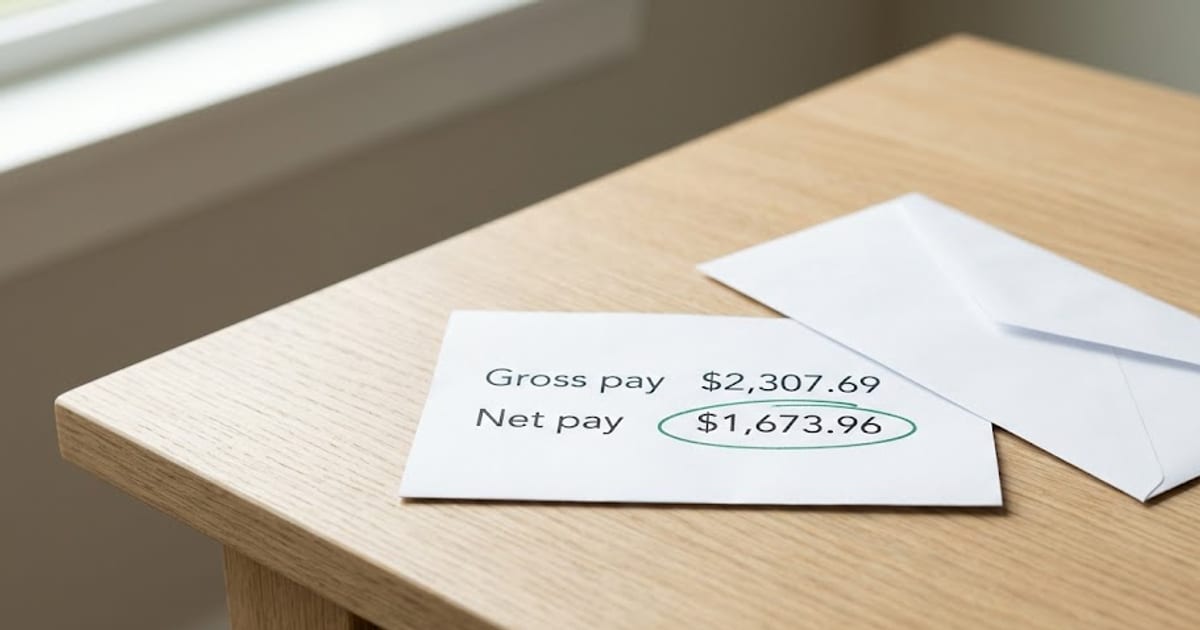
Most of the gap between your salary and your paycheck is tax, and most of the rest is deductions you signed up for. A $60,000 salary paid every two weeks is $2,307.69 gross per check. For a single filer in Columbus, Ohio, contributing 6% to a 401(k) and paying an average share of employer health insurance, the deposit is about $1,674. That is 27% less than gross, and every dollar of it has a line on the pay stub.
If the difference you are seeing is larger than that, or larger than last month, one of the ten reasons further down is usually responsible.
A $60,000 paycheck, line by line
| Line on the stub | Per year | Per paycheck (26) |
|---|---|---|
| Gross pay | $60,000.00 | $2,307.69 |
| 401(k), 6% pre-tax | −$3,600.00 | −$138.46 |
| Health insurance, pre-tax | −$1,440.00 | −$55.38 |
| Federal income tax | −$4,415.20 | −$169.82 |
| Social Security, 6.2% | −$3,630.72 | −$139.64 |
| Medicare, 1.45% | −$849.12 | −$32.66 |
| Ohio income tax | −$1,077.90 | −$41.46 |
| Columbus city income tax, 2.5% | −$1,464.00 | −$56.31 |
| Net pay | $43,523.06 | $1,673.96 |
Assumptions: single filer, 2026 federal brackets and $16,100 standard deduction, W-4 with no adjustments. The health premium is the average annual worker contribution for single coverage in the 2025 KFF Employer Health Benefits Survey, $1,440. Ohio tax uses the state schedule of $342 plus 2.75% of taxable income above $26,050, after the $2,150 personal exemption for incomes between $40,000 and $80,000. Federal withholding is shown as the annual tax spread over 26 checks, which is close to what the IRS percentage method produces for a steady salary.
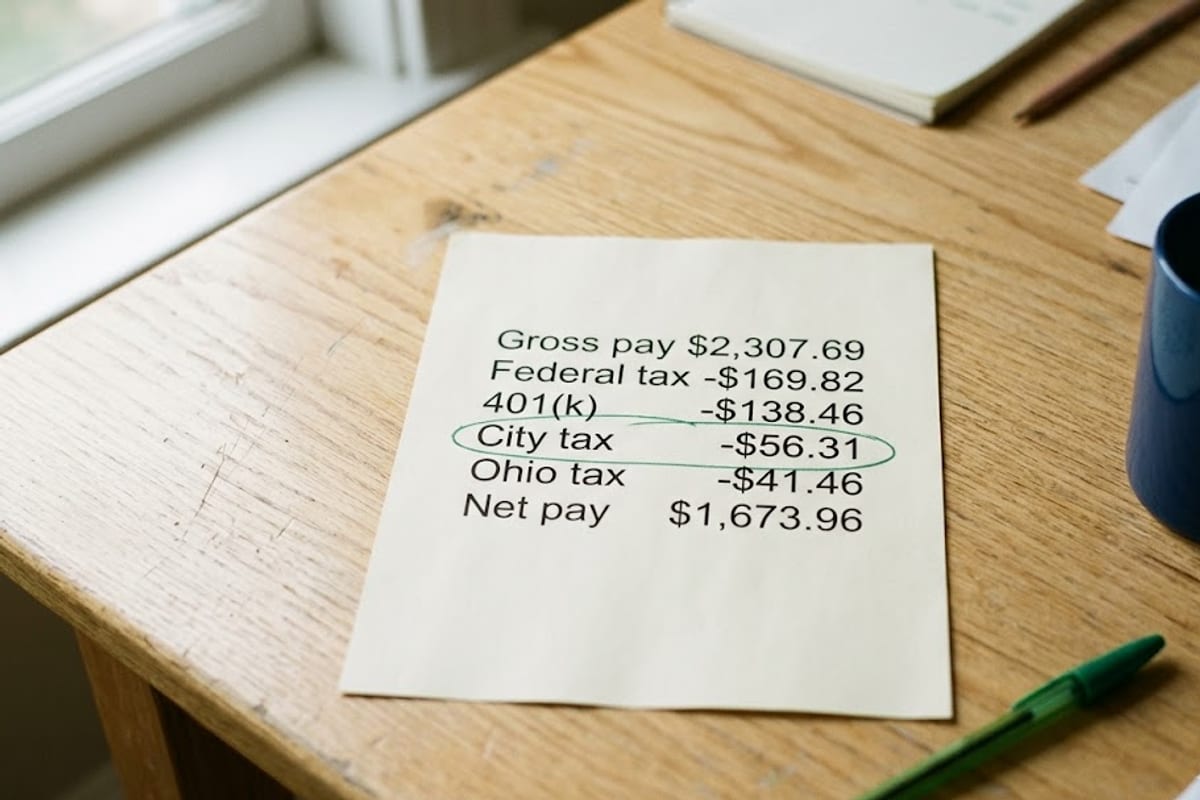
Two things stand out. The 401(k) contribution is the second-largest deduction, larger than Social Security, and it is money you keep. And the city tax is larger than the state tax. Ohio is one of several states where cities and school districts levy their own income tax, and many people moving from elsewhere do not budget for it.
Without the 401(k), health premium and city tax, the same salary takes home about $1,891 a check in Ohio; the full breakdown by salary is on the $60,000 after taxes in Ohio page. The distance between $1,891 and $1,674 is entirely choices and local rules, not federal tax.
Ten reasons a paycheck comes in lower than expected
1. You divided by 24 instead of 26
A $60,000 salary is $2,500 twice a month if you are paid semimonthly (24 checks), and $2,307.69 every two weeks if you are paid biweekly (26 checks). People who think of pay as "monthly salary split in half" expect $2,500 and see $2,307. Nothing is missing: biweekly workers get two extra checks a year, and in two months of the year they receive three. How to budget around that is covered in biweekly pay after taxes.
2. Your first check covers a partial period
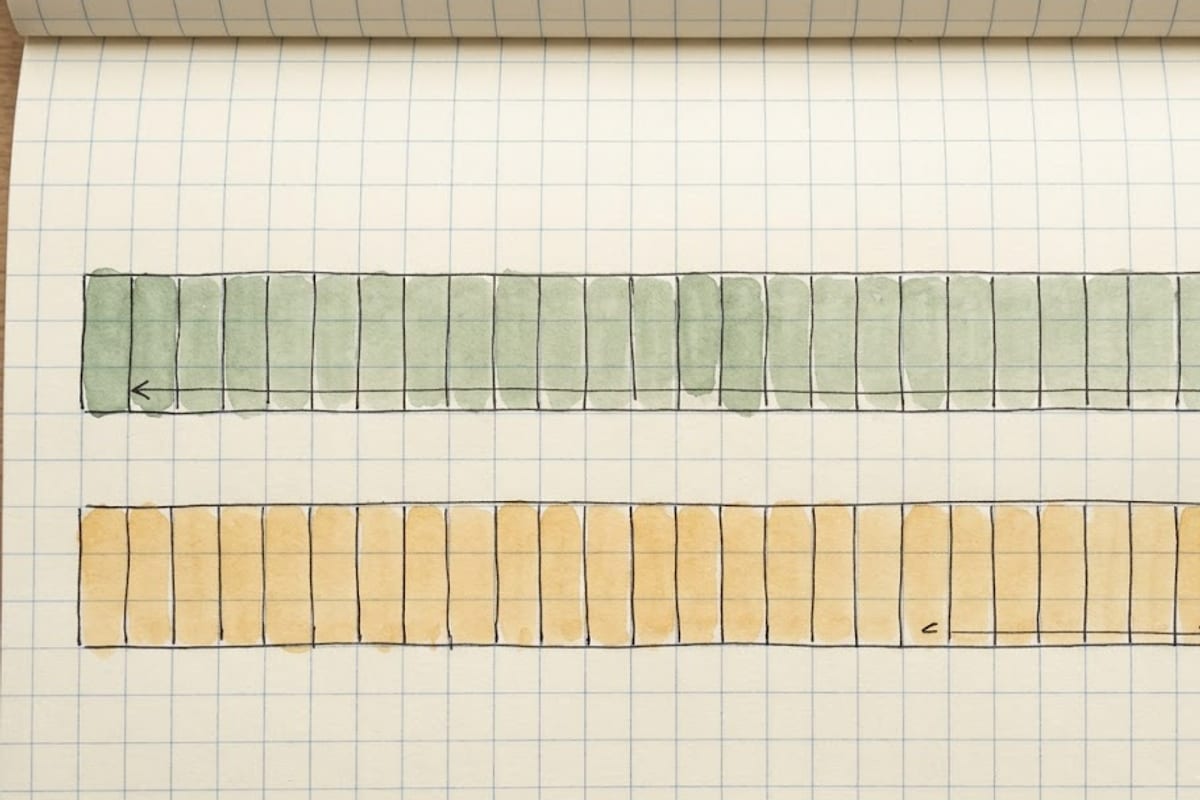
Most employers pay in arrears, a week or more after the pay period closes. If you started mid-period, the first check covers only the days you worked, and it may arrive later than you expect. The full amount starts with the second or third check.
3. Pre-tax deductions started
Benefits often begin on the first day of the month after you start, so the second or third check can suddenly drop by the cost of health, dental, vision and retirement contributions. Pre-tax deductions reduce your taxable income, so they cost you less than their face value: $138.46 into a 401(k) lowers federal tax by about $16.62 per check at a 12% bracket, and state and local tax by a little more.
4. FICA is 7.65% of nearly everything
Social Security (6.2%) and Medicare (1.45%) apply to wages up to $184,500 in 2026 for Social Security and without limit for Medicare. A 401(k) contribution does not reduce them. Health premiums paid through a cafeteria plan do. Above $200,000 in wages, an additional 0.9% Medicare tax applies.
5. Your W-4 is set up for one job
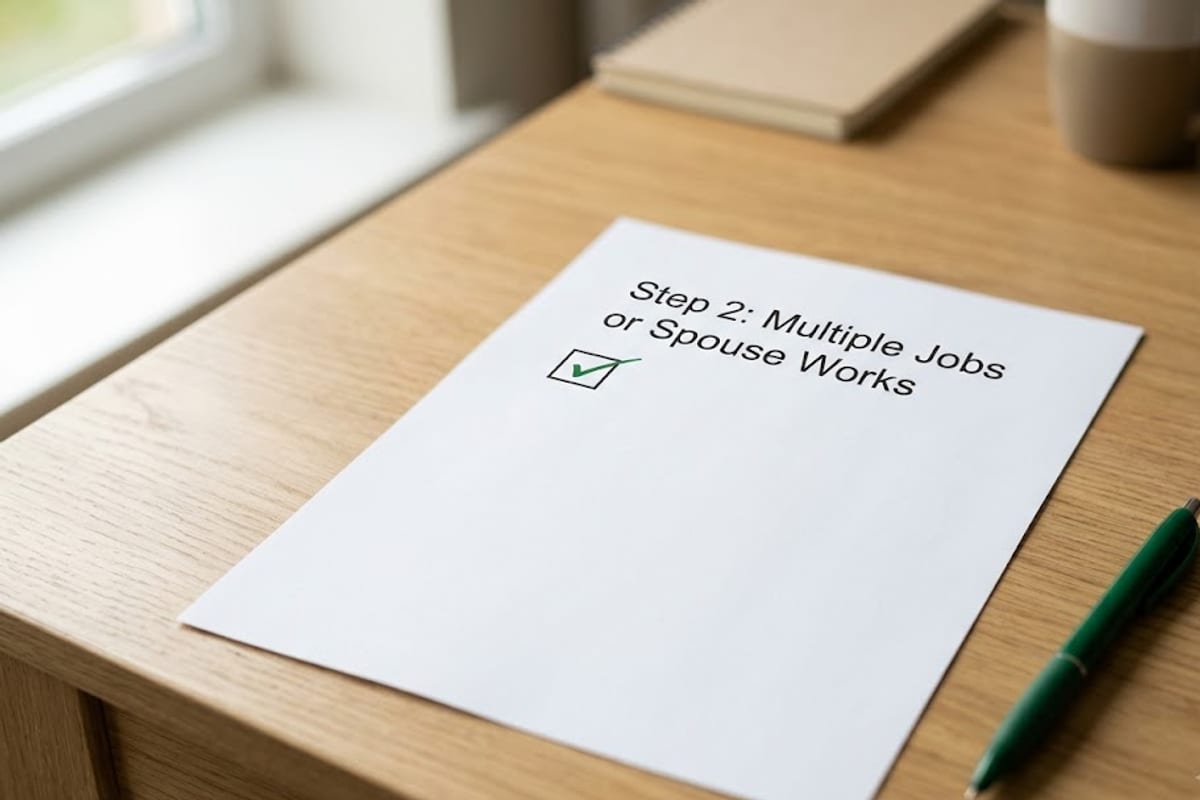
The W-4 you give your employer decides how much federal tax is withheld. If you have two jobs, or you and a spouse both work, each employer withholds as if its paycheck were your only income. That under-withholds, and the fix is Step 2 of the W-4. It does not make a single check smaller than expected, but it is the most common reason for a tax bill in April, and people who fix it then see a smaller check afterwards.
6. You received a bonus
Bonuses are supplemental wages. Employers may withhold federal income tax on them at a flat 22%, according to IRS Publication 15, plus 7.65% for FICA and any state tax. A $2,000 bonus loses about $593 before state tax, which feels like a lot. The 22% is withholding, not the final tax: if your actual bracket is 12%, the excess comes back when you file.
7. You worked overtime
Overtime can push a single check into a higher withholding bracket because the payroll system annualizes that one check. The tax is settled at the end of the year, and for 2025 through 2028 part of the overtime premium is deductible under the federal "no tax on overtime" rule, up to $12,500 a year. Withholding does not fully reflect that deduction during the year.
8. State and local taxes you did not know about
Beyond state income tax, some states take payroll contributions of their own. California withholds 1.3% of all wages for State Disability Insurance in 2026, with no wage cap. Washington, New York, New Jersey, Massachusetts and several others take smaller contributions for paid family leave or disability. Cities in Ohio, Pennsylvania, Michigan and Kentucky, and New York City, levy their own income taxes. A job that moves you across a city line can change a check by more than a raise does.
9. A garnishment or deduction you did not authorize
Child support, a tax levy, or a court-ordered garnishment will appear as its own line. So will a repayment of an overpayment from a previous check. If you see a deduction you do not recognize, ask payroll for the supporting paperwork; employers must be able to explain every line.
10. The raise was smaller after tax
A 3% raise on $60,000 is $1,800 a year before tax, but only about $1,446 after federal income tax and FICA, or $56 a check. People who expected their check to rise by 3% of $2,307 ($69) are surprised by a smaller change. A 3% raise on $60,000 shows the full calculation.
How to check your own stub
Start at the top and work down.
- Gross pay. Hours times rate for hourly workers, or annual salary divided by the number of pay periods for salaried workers. If this line is wrong, stop here and contact payroll, because every line below it is computed from it.
- Pre-tax deductions. Compare with the benefits you elected. They should match your enrollment confirmation exactly.
- FICA. Social Security should be 6.2% and Medicare 1.45% of gross pay minus any cafeteria-plan deductions. These are the easiest lines to check with a calculator.
- Federal and state withholding. These depend on your W-4 and state form. The IRS Tax Withholding Estimator will tell you whether your federal withholding is on track for the year.
- After-tax deductions. Roth 401(k), union dues, garnishments.
- Net pay. Gross minus everything above.
If the numbers match your elections and the percentages hold, the check is correct even if it is smaller than you hoped. The level of take-home in your state before any benefit deductions is on the take-home pay pages.
Frequently asked questions
Why did my paycheck go down when nothing changed? The common causes are benefits renewal in January, a new calendar year restarting Social Security withholding for high earners who had passed the wage base, or a change in state or local tax rates on January 1.
Why is my paycheck less than my coworker's at the same salary? Different W-4 settings, different benefit elections, and different home addresses where local taxes depend on where you live.
What percentage of my paycheck goes to taxes? For a single filer at $60,000, federal income tax and FICA take about 16% of gross before pre-tax deductions. State and local taxes add 0% to 5% depending on where you live.
Sources
- Internal Revenue Service: Rev. Proc. 2025-32 (2026 brackets and standard deduction); Publication 15 (2026), supplemental wage withholding at 22%; Form W-4; "What to know about the No Tax on Overtime deduction."
- Social Security Administration: 2026 contribution and benefit base, $184,500.
- KFF, 2025 Employer Health Benefits Survey (average worker contribution, single coverage).
- California Employment Development Department: 2026 SDI withholding rate.
- Ohio Department of Taxation and City of Columbus Income Tax Division: 2026 rates.